
1
Prompt fit
The product satisfies the shopper’s stated use case, budget, audience, and constraints.
ChatGPT shopping visibility connects the buyer’s question to the products selected, the reason each one is recommended, the merchant destination, and the competitors occupying the same answer.
Example buyer prompt
“Which lightweight running shoes offer cushioning for long tempo runs?”
Product picked
Reason given
Merchant shown
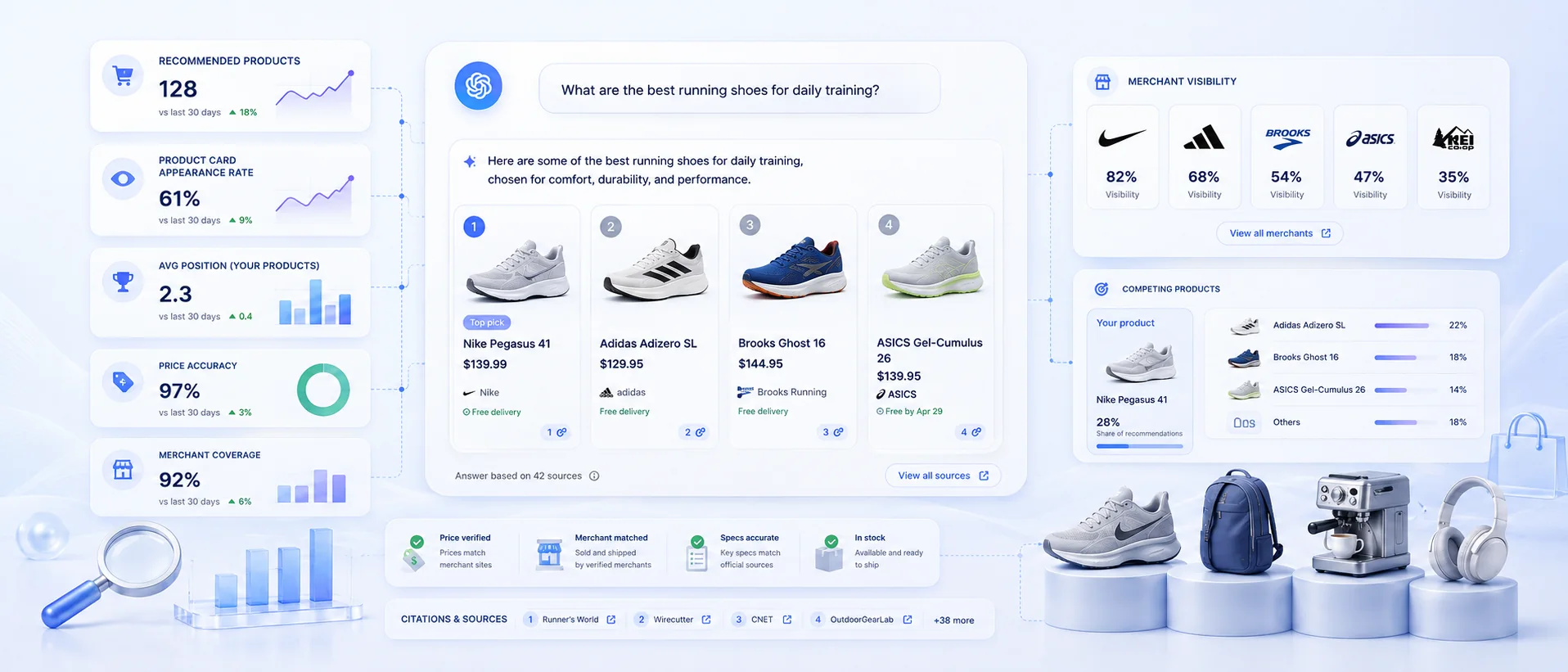
Anatomy of an answer
The product satisfies the shopper’s stated use case, budget, audience, and constraints.
The product enters the answer, shortlist, comparison, or shopping card set.
The rationale explains why it fits, including strengths, trade-offs, and intended buyer.
The shopper receives a link to the brand, marketplace, retailer, or another seller.
Names, attributes, prices, variants, availability, and positioning remain accurate.
Two visibility questions
Product visibility and merchant visibility can diverge. ChatGPT may recommend the correct product but route demand to a marketplace. Track both so ecommerce teams can distinguish category awareness from direct commercial opportunity.
Recommendation frequency, position, rationale, product facts, and competitor overlap.
Which seller receives the link, how often your domain appears, and where third parties intercept demand.
How discovery unfolds
A shopper can begin with a broad need, add a budget, reject an option, upload a reference image, or ask for a side-by-side comparison. The candidate set can change as those constraints become clearer. Monitoring only the first answer misses that journey.
The shopper describes the job to be done: a laptop for gaming, a stroller for mixed terrain, or a gift for someone with a particular hobby.
Budget, size, material, compatibility, audience, availability, and preferred features narrow the eligible product set.
Current product pages and other public retail information help establish prices, availability, specifications, images, reviews, and trade-offs.
Products are summarized against the stated needs. The commercially useful question is not just whether your item appears, but why it was selected.
A shopper may click through to a brand, retailer, or marketplace. The chosen destination determines who captures the demand.
Build the right prompt set
A useful benchmark mixes broad discovery with detailed constraints. It should resemble real product research rather than a list of keyword variations.
Category discovery
“What are the best standing desks for a small home office?”
Tests whether the brand enters an unbranded shortlist.
Problem and use case
“Which shoes reduce fatigue on long hospital shifts?”
Connects product attributes to an actual buyer need.
Budget and value
“Best noise-cancelling headphones under $250?”
Tests eligibility when price becomes a hard constraint.
Comparison
“Compare Product A and Product B for frequent travel.”
Reveals trade-offs, factual gaps, and positioning.
Compatibility
“Which charger works with this laptop and supports travel adapters?”
Tests exact technical and relationship data.
Local availability
“What can I buy in Germany with delivery this week?”
Separates global awareness from market-ready inventory.
Card and answer audit
For every eligible run, preserve enough context to explain the outcome later. A product may be recommended accurately but paired with a stale price, an unavailable variant, or a retailer that competes with your direct channel.
Related intelligence
Common questions
It measures how often products appear in relevant shopping answers, their position and framing, the merchants shown, and the sources or product facts supporting the recommendation.
Not always. A descriptive mention, a recommended shortlist, and a product card with a purchase path are different outcomes and should be classified separately.
Yes. ChatGPT may use a different mix of public product information, merchant data, sources, and query constraints when assembling an answer.
Yes. A product may be visible while the purchase link points to a marketplace or third-party retailer rather than the brand website.
Move from assumptions to recurring evidence
Monitor buyer prompts, product recommendations, competitors, citations, and shopping visibility across supported AI platforms.