
Recommendation share by model
Measure visibility by provider and prompt, then spot where your brand wins or slips.
Platform Features
Monitor recommendation share across leading LLMs, audit cited sources and sentiment, track competitors, and convert AI signals into execution-ready marketing actions from one workspace.
Monitor
See how often each major LLM recommends your brand across prompts, comparisons, and buying questions that matter.
Audit
Review sources, sentiment direction, and response quality before stale claims spread across category and pricing conversations.
Activate
Generate briefs, page updates, and campaign actions from AI visibility changes.
At A Glance
The features page now mirrors the landing-card language: attached panels, cleaner hierarchy, and feature groups that match real workflows instead of a generic list.
Measure visibility by provider and prompt, then spot where your brand wins or slips.
Track saved competitors in AI answers instead of relying on random category lists.
Identify high-impact pages cited by LLMs and see which ones exclude your brand.
Summaries and trend narratives built from aggregated prompt performance data.
Send alerts and workflows into Teams, Slack, CRM tools, and your marketing stack.
Manage brands, sub-brands, and teams in one workspace with shared governance.
Live server signal
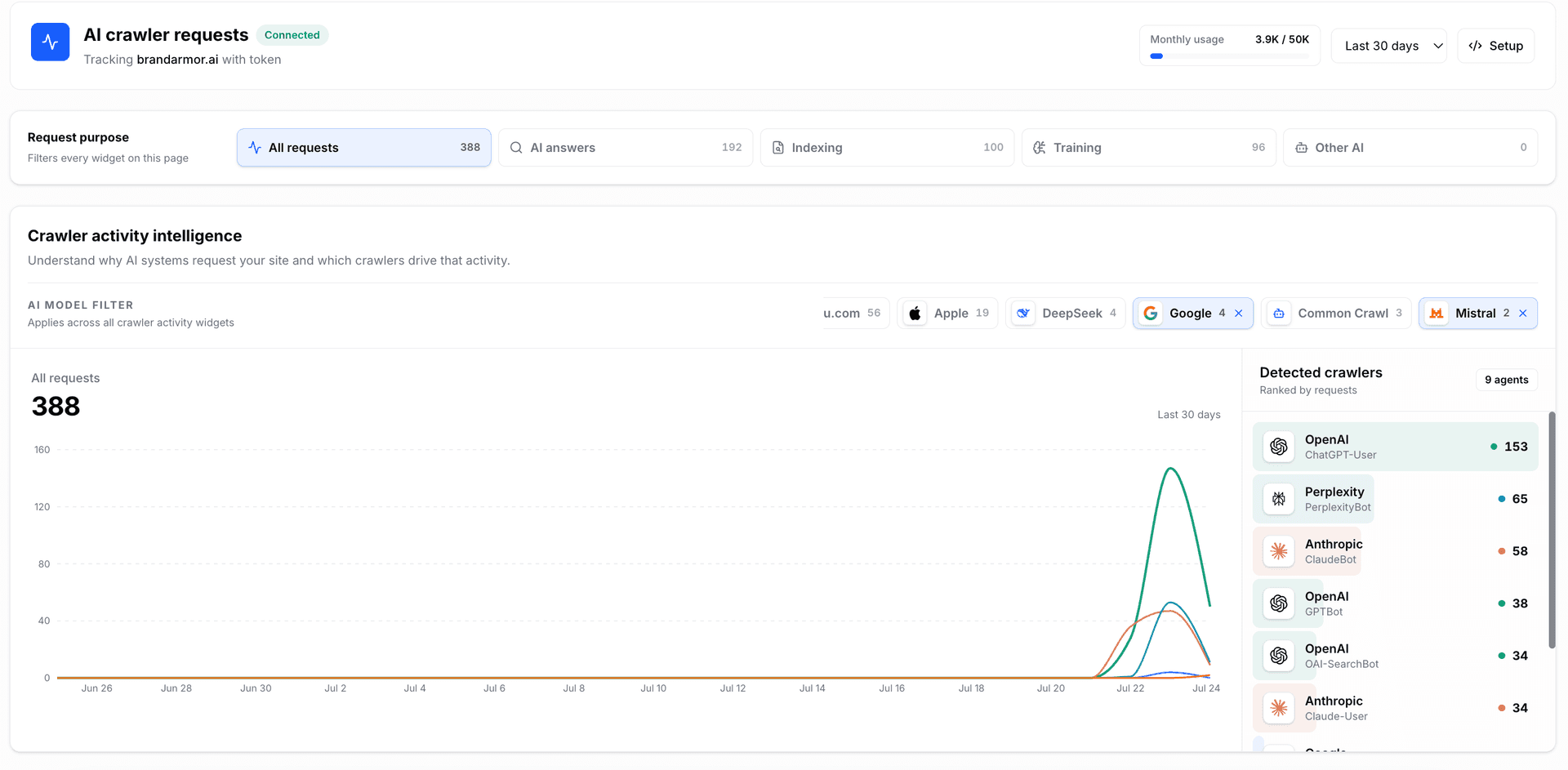
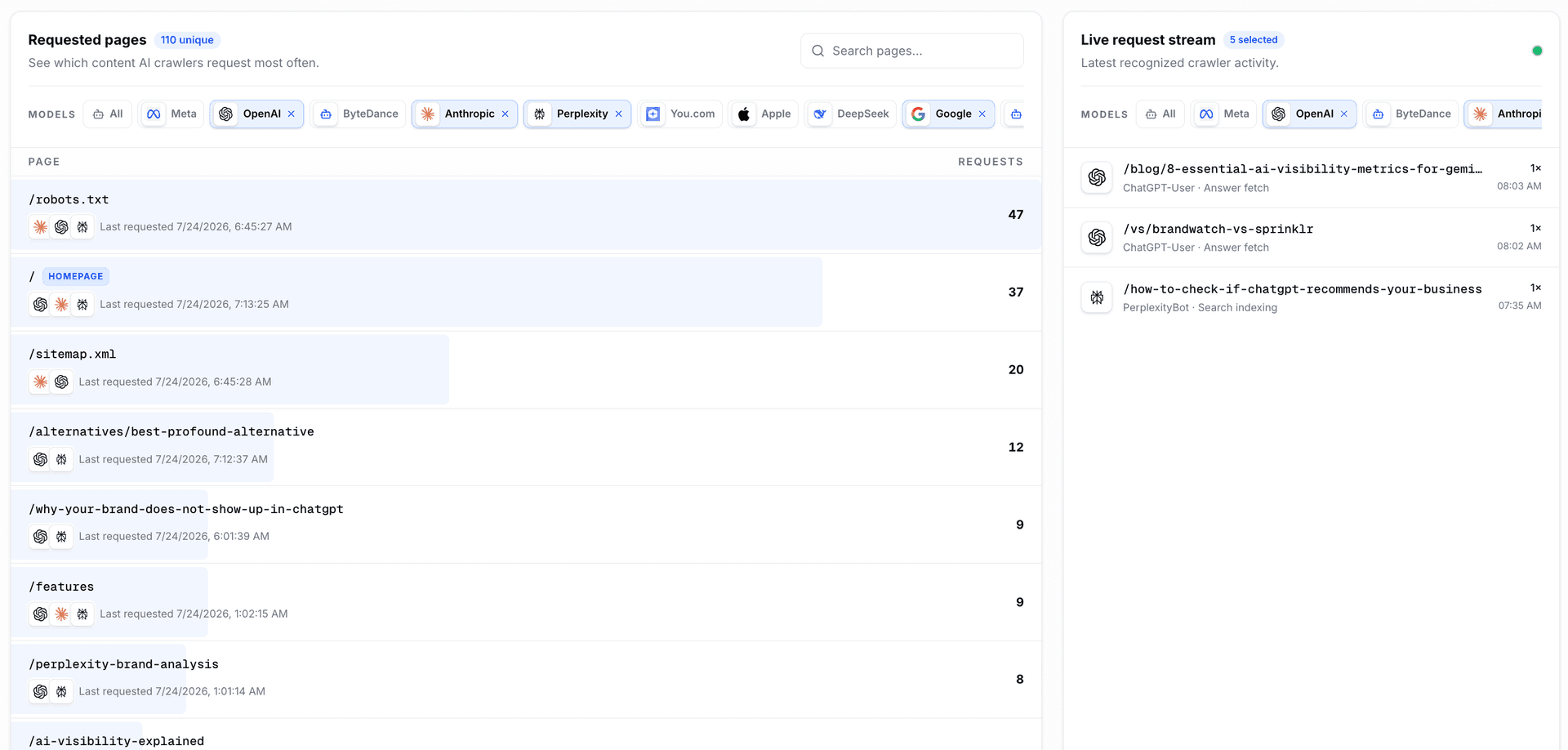
Browser analytics misses many automated requests. Brand Armor AI records eligible requests from recognized AI crawlers and user-triggered agents on the server, giving your team direct evidence of which pages they reached and when.
A crawler request confirms access. It does not by itself prove indexing, model training, citation, or recommendation, and it does not expose the AI user’s original prompt.
Inspect crawler, provider, URL, time, status, and available purpose.
Find frequently requested URLs and gaps across priority pages.
Filter OpenAI, Anthropic, Perplexity, Google, and other recognized ecosystems.
Spot failed responses and access problems before they become persistent blind spots.
Brand Intelligence
A cleaner operating view for marketing teams: monitor recommendations, verify citations, defend against competitor shifts, and execute updates from one surface.
AI Shelf Share
One dashboard shows how often ChatGPT, Claude, Gemini, Perplexity, and Grok recommend your brand versus competitors.
Source Intelligence
See every source behind AI answers, who owns it, and which high-impact pages mention competitors instead of your brand.
Top cited pages this week
runnersworld.com
Mentions Youhttps://runnersworld.com/blog/...
simpleanalytics.com
Not Mentionedhttps://simpleanalytics.com/blog/...
remote3.co
Not Mentionedhttps://remote3.co/blog/...
Competitive Defense
Detect when rivals start winning key prompts, then launch a targeted recovery plan before share loss compounds.
Competitive movement
best crm for startup teams
competitor-alpha.com
top b2b analytics tool
competitor-beta.com
ai visibility software
brandarmor.ai
Execution Layer
Convert visibility and sentiment insights into content updates, campaign ideas, and AI-ready publishing briefs.
Action pipeline
Detect high-intent prompt opportunity
Generate update brief and source checklist
Publish and monitor recommendation lift
Connect with the tools you already use across 200+ platforms. Get insights delivered directly to your team.







GEO Workflow
GEO in Brand Armor AI is not abstract optimization. It is an operating flow: audit what AI says, fix the pages and sources models rely on, then track whether recommendation share improves.
Optimization Layer
From AI observations to execution
Step 1
Map citation sources, answer patterns, and recurring brand claims before changing content.
Step 2
Turn scattered brand facts into clean source pages, structured data, and publish priorities.
Step 3
Generate briefs, publish fixes, and monitor if visibility and sentiment improve after rollout.
Guardrails
Keep brand claims consistent across teams
Shared rules help regional teams ship faster without drifting from brand positioning.
Output
Blog and campaign actions from real AI signals
Convert source gaps and prompt shifts into briefs, blog drafts, and UGC campaign ideas.
GEO Signal Snapshot
Live82
AI Readiness Score
67%
Source Coverage
14
Fix Priority Pages
9
Citation Gaps
Fix Priority Queue
This week/pricing
HighCompetitor cited instead
/features
MediumOutdated positioning line
/compare/chatgpt-monitoring
MediumMissing benchmark source
Optimization Engine Visual
Audit input, package facts, measure lift
Enterprise Scale
Manage parent brands, regional entities, and product lines in one operating layer. Compare visibility, sentiment, and citations side by side without losing brand-specific context.
12
Tracked Brands
5
AI Providers
34
Teams
18
Alerts Today
Brand + sub-brand hierarchy
Keep strategy centralized while each brand keeps its own prompts and competitors.
Role-based access controls
Control who can monitor, run analyses, and publish changes for each brand.
Unified reporting layer
Compare recommendation share, sentiment, and source coverage across portfolio brands.
Shared governance rules
Apply policies once, then sync operating standards across every workspace.
Brand Topology
Shared governance, local execution
Brand Group
Global governance
EU Sub Brand
Regional prompts
US Product
US competitors
APAC Brand
Local teams
Portfolio Control Center
Cross-brand visibility and governance
Main Brand
Global
Visibility
42%
Sentiment
78
EU Sub Brand
Europe
Visibility
31%
Sentiment
71
US Product Line
North America
Visibility
27%
Sentiment
75
Portfolio Trend
Last 7 daysCoverage Matrix
Brand x ProviderPolicies
12 active
Shared governance rules across brands
Access
34 users
Scoped roles by brand and team
Platform Coverage
Jump directly into provider-specific monitoring pages for focused AI visibility workflows.
ChatGPT Brand Monitoring
Monitor how ChatGPT recommends, cites, and describes your brand.
Claude Brand Monitoring
Track Claude responses, sentiment, and source behavior for your brand.
Gemini Brand Tracking
Measure Gemini visibility and compare recommendation share versus competitors.
Grok Brand Monitoring
Monitor real-time mention behavior and positioning in Grok responses.
Deep Workflows
Go deeper into visibility intelligence, trust reporting, and content execution systems.
Prompt Monitoring
Track recommendation wins, citations, and prompt-level visibility across AI providers.
Hallucination Detection
Identify false claims, weak source patterns, and brand-risk answers before they spread.
Content Gaps + Content Engine
Turn citation and ranking gaps into publish-ready briefs, blogs, and campaigns.
Live AI Crawler Monitoring
See which recognized AI crawlers request priority pages and where technical coverage breaks.
Technical FAQ
Implementation, monitoring, governance, and competitive analysis questions for teams evaluating the platform at depth.
GEO is the practice of optimizing content for AI-driven search and language models, distinct from traditional SEO. It focuses on how AI systems understand, interpret, and cite your content in responses, requiring structured data, authoritative sourcing, and AI-friendly content formatting.
While SEO targets web crawlers and ranking algorithms, GEO optimizes for AI understanding and citation. GEO requires content structured for language model comprehension, focuses on factual accuracy over keyword density, and prioritizes authoritative sources that AI systems trust.
AI systems prioritize authoritative sources, factual accuracy, content freshness, and consistency across multiple trusted sources. They favor brands with clear, well-documented information, strong domain authority, and presence in training data from reputable publications.
AI honeypots are specialized content endpoints designed to capture AI agent attention and provide optimized brand information. They contain structured, AI-friendly data that helps language models access accurate brand details, improving visibility and reducing hallucinations.
AI brand monitoring tracks how your brand is mentioned, described, and represented across AI platforms like ChatGPT, Claude, Gemini, and Perplexity. It includes accuracy analysis, sentiment tracking, competitive positioning, hallucination detection, and compliance monitoring.
Brand Armor AI provides comprehensive brand knowledge audits across AI platforms, showing exactly what information AI systems have about your company, identifying gaps or inaccuracies, and providing optimization recommendations for better representation.
Marketing teams can use Brand Armor AI to monitor brand messaging consistency, set up alerts for off-brand mentions, optimize content for AI consumption, track competitive positioning, and maintain message control across all major language models.
Enterprise brand accuracy requires centralized monitoring across all AI platforms, automated fact-checking against brand databases, real-time alerts for inaccuracies, standardized correction protocols, and continuous optimization based on AI response patterns.
Brand Armor AI provides competitive analysis by comparing your brand's AI platform visibility against competitors, analyzing share of voice, tracking competitive positioning, identifying gaps in AI optimization, and providing strategic recommendations for market advantage.
Enterprise features include multi-brand monitoring, custom compliance reporting, API integrations, team collaboration tools, advanced analytics dashboards, white-label solutions, dedicated support, and enterprise-grade security and data governance.
Live AI Crawler Monitoring records recognized server-side crawler and agent requests. It shows requested pages, crawler and provider identity, request time, response status, available purpose classification, activity trends, provider coverage, and crawler health. A crawler request confirms access only; it does not by itself prove indexing, training, citation, recommendation, or reveal the user’s original prompt.
Brand Armor AI offers customizable automated alerts for brand mentions, sentiment changes, accuracy issues, competitive activity, and compliance violations across all AI platforms with real-time notifications via email, Slack, or API webhooks.
Key metrics include visibility score, mention frequency, sentiment analysis, accuracy rating, share of voice vs. competitors, citation rate, hallucination incidents, and platform-specific performance indicators tracked through comprehensive Brand Armor AI dashboards.
Looking for basic questions? Check our complete FAQ.
View Complete FAQNext Step
Launch your workspace, monitor how models recommend your brand, and build a repeatable workflow for fixes, publishing, and reporting across your team.
Recommended Path
Create your workspace and connect your domain
Monitor prompts, sources, and competitor movement
Scale executions, automation, and governance as your team grows


