
AI answer fetches
Separate user-triggered retrieval agents from broad background crawling so you can see when an AI system requests a page to help form an answer.
Real-time AI search data from your own website
See recognized AI crawlers and agents request your website as activity happens. Understand which systems arrive, which pages they reach, why they are visiting, and where technical coverage breaks.
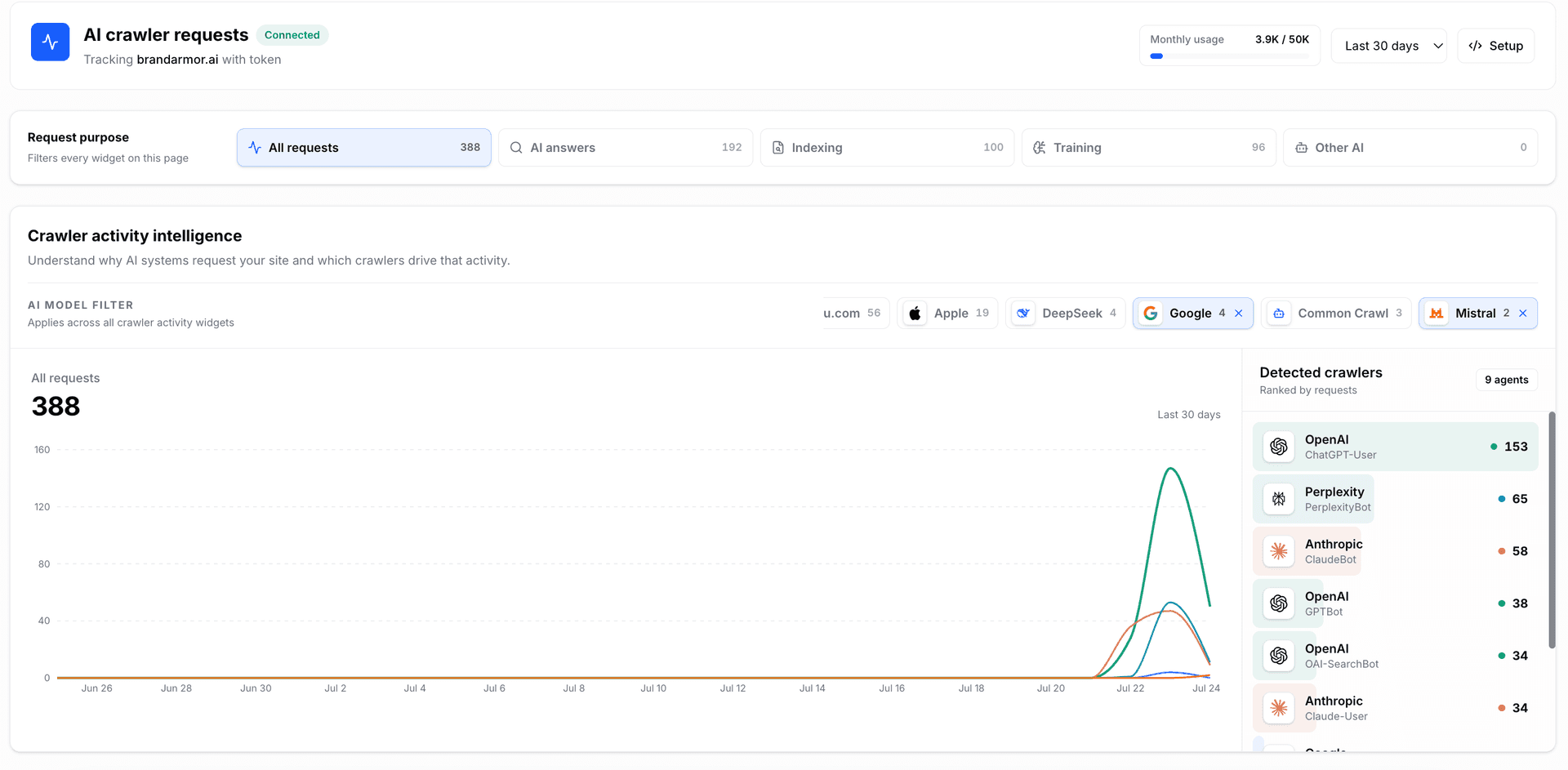
Watch a real Claude request appear inside Brand Armor AI as it happens. Confirm which AI agent reached your site, the exact page it requested, and why the request was classified.
Crawler purpose
A training crawler, a search crawler, and an agent fetching a page for an answer represent different events. Brand Armor AI separates recognized requests by purpose and lets the same top-level filter update the activity chart, requested pages, live stream, coverage matrix, and network-origin view.
Separate user-triggered retrieval agents from broad background crawling so you can see when an AI system requests a page to help form an answer.
Identify crawler activity associated with AI search discovery and inspect the exact routes receiving those requests.
Keep model-training crawler activity distinct from answer retrieval and AI search activity instead of combining every bot into one total.
Review recognized AI traffic that does not cleanly fit answer, indexing, or training categories while preserving the underlying crawler identity.
Search the URLs AI systems request most, compare request volume, inspect the last request time, and filter by provider. The live stream shows the latest recognized activity with the crawler identity and classified purpose.
This gives SEO, GEO, content, and engineering teams shared evidence from the server instead of relying on browser analytics that many crawlers never execute.
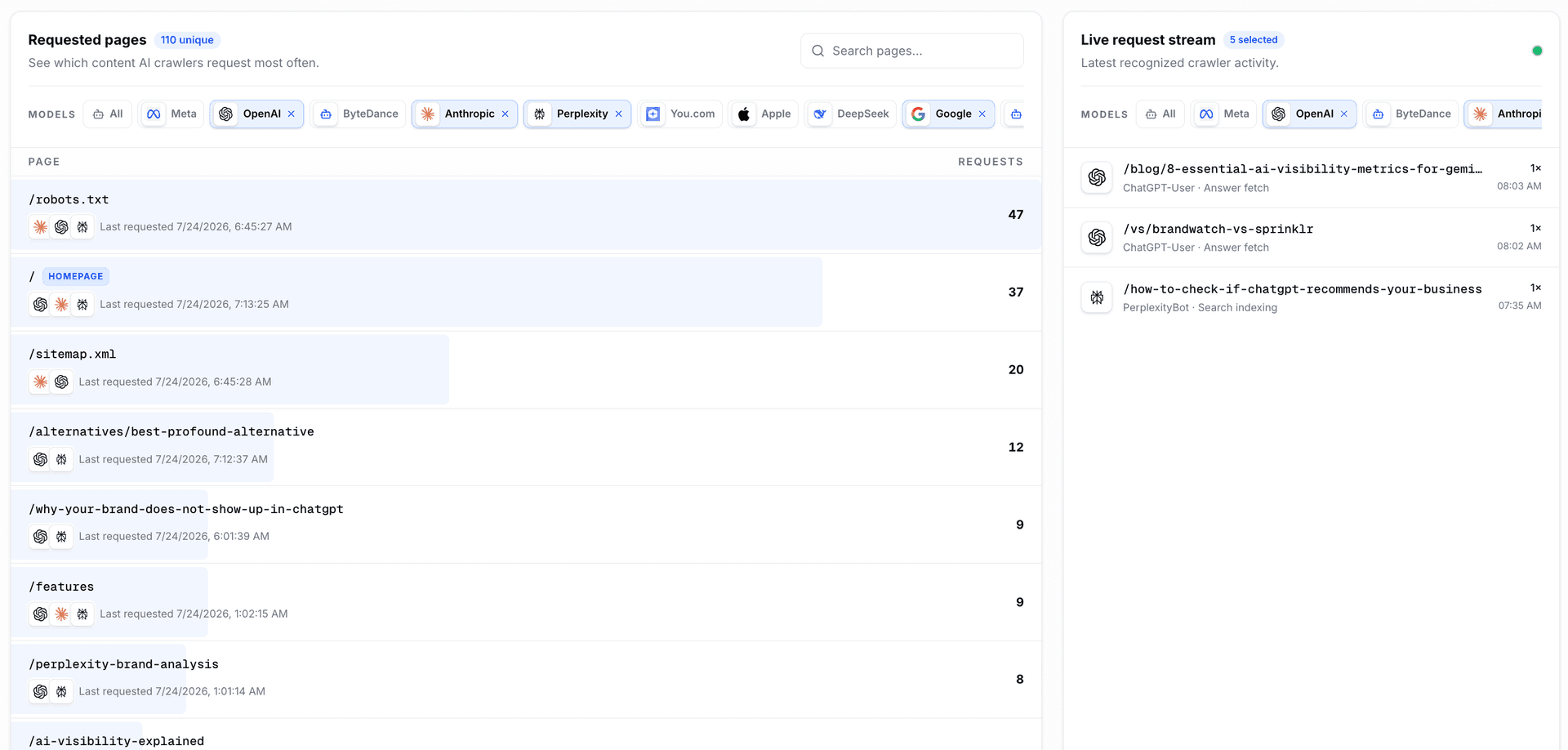
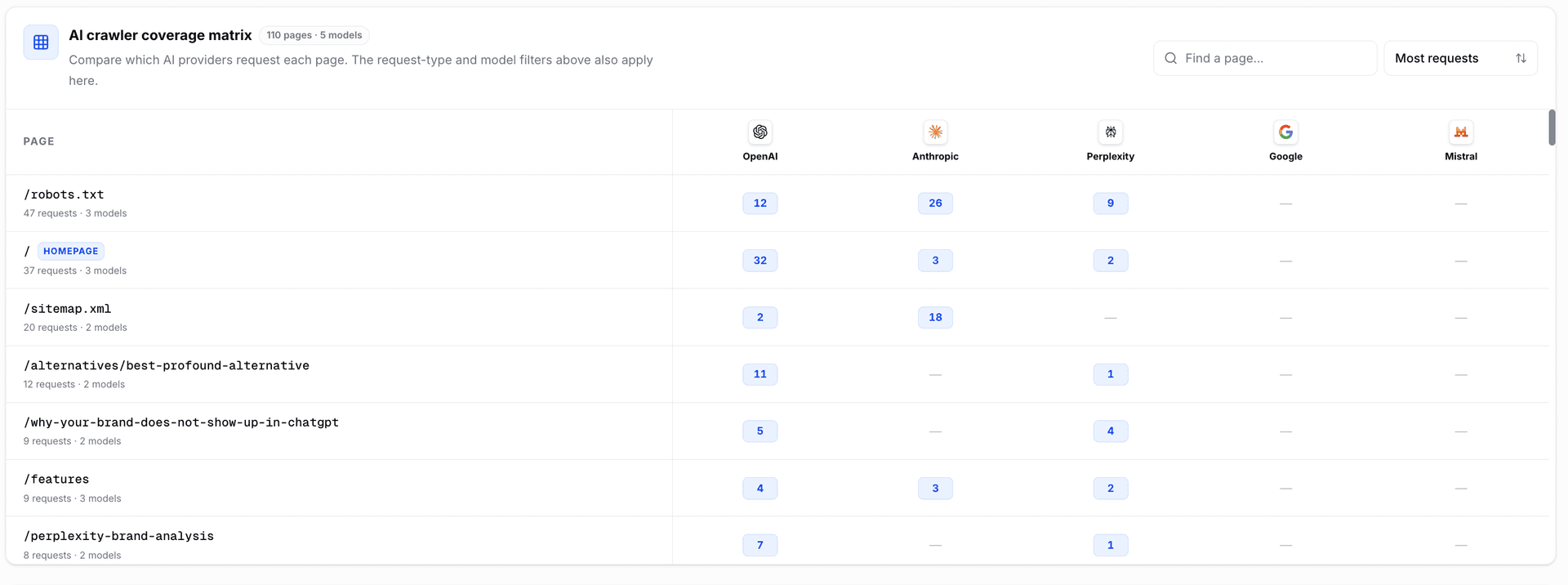
The AI crawler coverage matrix compares requested pages across providers. Search for a priority URL, sort by request activity, and see whether OpenAI, Anthropic, Perplexity, Google, Mistral, or another recognized ecosystem has reached it.
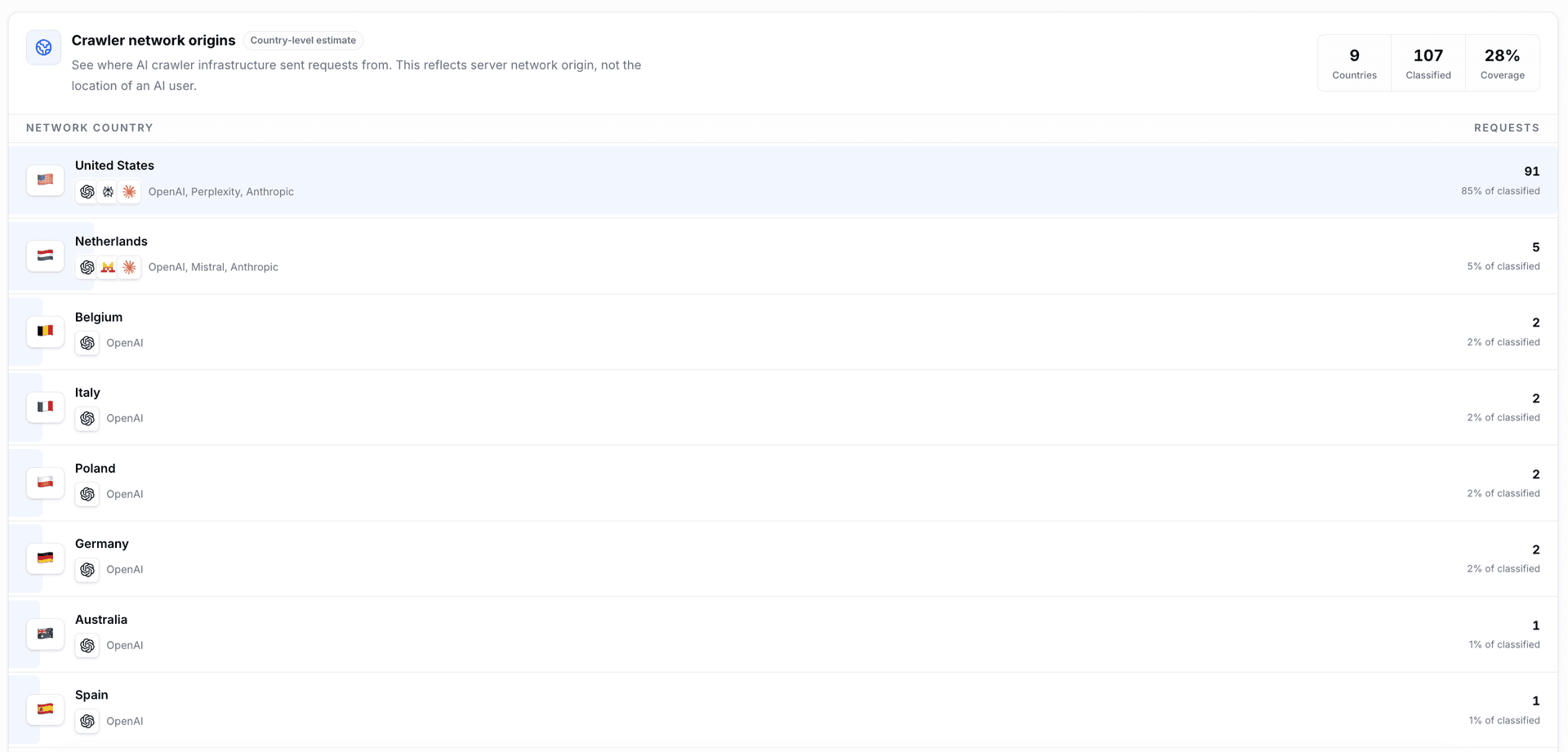
When trusted platform metadata is available, Brand Armor AI groups classified requests by estimated crawler network country. This can help technical teams understand infrastructure patterns and unclassified coverage.
Interpret this correctly
Network origin reflects crawler infrastructure, not the location of a person using ChatGPT, Claude, Perplexity, or another AI service.
Evidence, not assumptions
Crawler access matters, but it is not the final business outcome. Brand Armor AI keeps technical access, generated answers, citations, and content actions connected without collapsing them into one misleading metric.
Confirms that a recognized AI crawler or agent requested a URL on your server.
Observed server request
Shows how AI platforms answer the buyer questions your team tracks and whether your brand appears.
Observed AI answer
Shows which owned and third-party sources appear as supporting references in captured AI answers.
Observed citation
Turns missing coverage, weak sources, and competitive losses into pages and updates your team can ship.
Prioritized action
From signal to action
The useful question is not only “did an AI bot visit?” It is whether the right systems can reach the right commercial pages, whether those pages influence answers, and what prevents your brand from being recommended.
Learn how AI visibility worksCompare high-crawl pages with prompt results and citations to learn whether access is translating into useful AI visibility.
Open AI Visibility ExplorerUse the page-by-provider matrix to spot coverage gaps, then review robots, source strength, and answer-ready content.
Check crawler guidanceWhen AI can reach your content but still recommends competitors, compare positioning, citations, and recommendation share.
Review competitive intelligenceMove from crawler and answer signals into briefs, content gaps, blog drafts, and prioritized page updates.
Explore the Content Gaps EngineInstall the Brand Armor AI package, add the website ID and crawler token to the server environment, then connect the adapter for your runtime.
npm install @brandarmorai/ai-search-crawlerRuns on the server and keeps the crawler token out of browser JavaScript.
Tracks eligible GET and HEAD requests from recognized candidate user agents.
Removes URL query strings by default and excludes API, framework, and static paths.
Uses fail-open delivery so analytics does not block the website response.
Questions
Live AI crawler monitoring records recognized server requests from AI crawlers and user-triggered AI agents. It shows which crawler requested the site, which URL it requested, when the request happened, and the crawler purpose classification available for that user agent.
No. A request proves that a recognized crawler or agent reached the page. It does not by itself prove indexing, model training, citation, recommendation, or inclusion in an AI answer. Brand Armor AI keeps crawler activity, prompt results, and citations separate so teams can evaluate each stage correctly.
No. Standard crawler requests do not expose the original user prompt. User-triggered agent activity can indicate that an AI system fetched a page while forming an answer, but the exact question remains private to the AI platform.
Brand Armor AI classifies recognized candidate user agents associated with major AI ecosystems, including OpenAI, Anthropic, Perplexity, Google, Meta, Mistral, DeepSeek, You.com, Apple, and other supported crawlers. Detection coverage can expand as providers introduce or change crawler identities.
No. Country data is a best-effort estimate of the crawler infrastructure network origin when trusted hosting metadata is available. It is not the location of the person using an AI assistant, and the dashboard labels it accordingly.
The server-side Brand Armor AI package supports Next.js, Express, Cloudflare Workers and Pages, Hono, and Fetch-compatible runtimes including Bun and Deno. The workspace provides a website ID and server-side token during setup.
Tracking is designed to be fail-open and not delay the visitor response. The server package evaluates recognized candidate user agents, tracks eligible GET and HEAD requests, removes query strings by default, and keeps the crawler token in the server environment.
Browser analytics primarily measures human sessions and client-side behavior. Many AI crawlers do not execute browser analytics scripts. Brand Armor AI records eligible crawler requests on the server, then connects that technical signal with AI visibility, prompt, citation, competitor, and content-gap workflows.
Start collecting real crawler request data, connect it with AI answer visibility, and turn technical access into a clearer optimization workflow.