
Conversational discovery
ChatGPT Shopping
The buyer describes needs, adds constraints, compares trade-offs, and receives a synthesized set of products and reasons.
Both help people discover products, but the experience, visibility unit, competitive context, and measurement model are not interchangeable.
Conversational discovery
The buyer describes needs, adds constraints, compares trade-offs, and receives a synthesized set of products and reasons.
Search and listing discovery
The buyer searches, scans listings, applies filters, compares offers, and moves through established merchant and advertising surfaces.
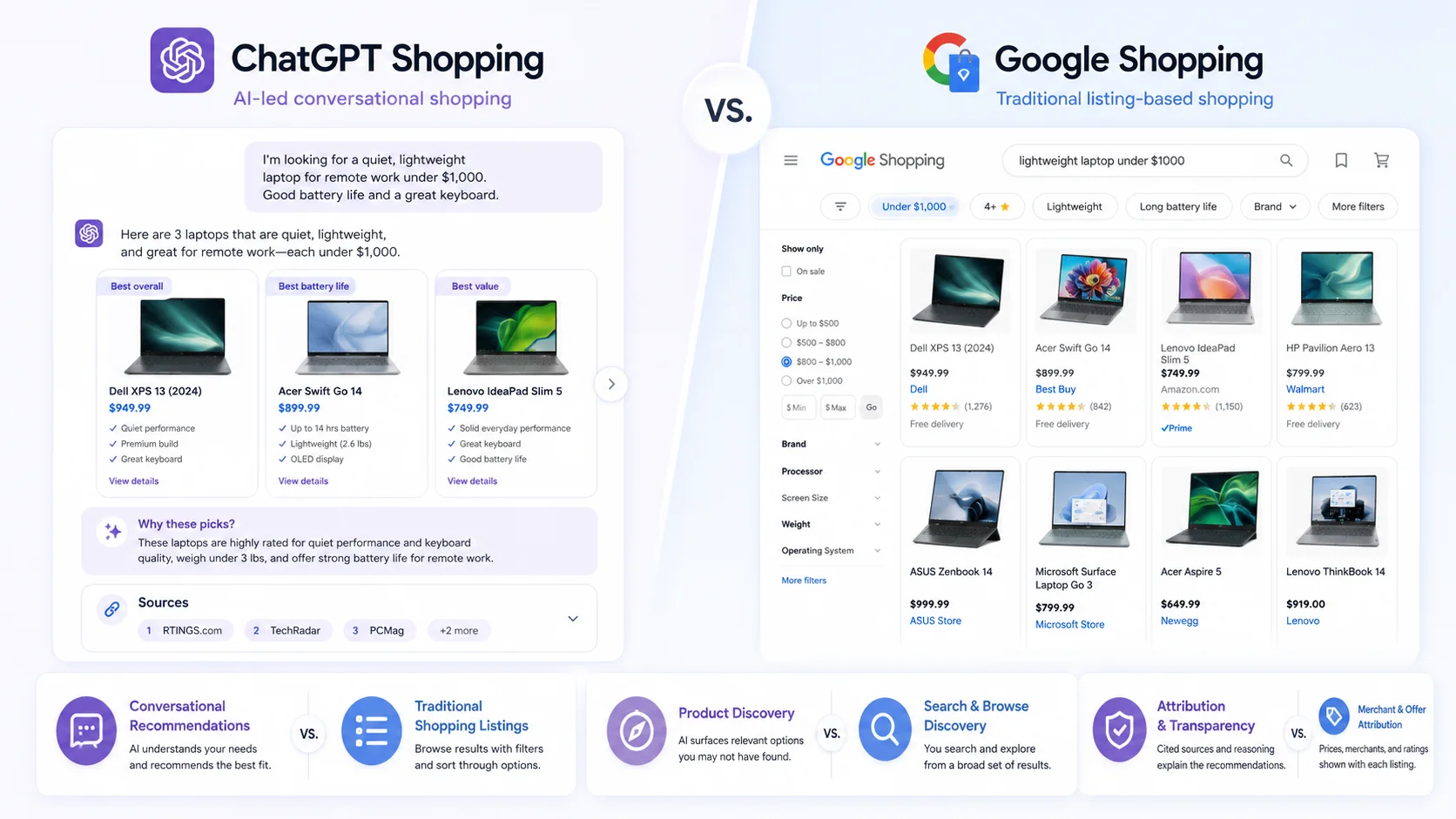
Side-by-side
| Dimension | ChatGPT Shopping | Google Shopping |
|---|---|---|
| Starting point | A conversational product need with follow-up context | A query, category, product, or shopping results page |
| Discovery flow | Iterative questions, comparisons, constraints, and summaries | Listings, filters, merchant results, and product pages |
| Visibility unit | Recommendation, shortlist position, rationale, and merchant path | Listing impression, placement, click, and merchant offer |
| Competitive set | Products selected as relevant to the conversation | Products eligible and surfaced for the query or feed context |
| Content role | Product facts, comparisons, sources, and public context shape the answer | Feed quality, merchant data, landing pages, relevance, and campaign setup can matter |
| Attribution | May include referral traffic, but many answer interactions remain clickless | Established impression, click, campaign, and conversion measurement |
Use both intelligently
Product names, specifications, variants, policies, and merchant facts should remain consistent. The monitoring layer then adapts to the surface: recommendation visibility for conversational AI and established listing or campaign metrics for Google Shopping.
Accurate product facts, accessible pages, consistent merchant information, and useful buyer content.
Prompts, products, recommendation states, reasons, citations, competitors, and merchant paths.
Eligible products, impressions, listing placement, clicks, campaign data, and conversions where configured.
See whether visibility grows across discovery surfaces or only within one channel.
Avoid the reporting mistake
AI answers can vary with wording and context. Use recurring controlled prompts and trend language. Keep the definitions of recommendation, shortlist, mention, citation, and merchant destination explicit.
The buying journey
In a conversational flow, the assistant can ask follow-up questions, search public retail sources, summarize trade-offs, and return a smaller set of products. In a listing flow, the shopper sees a broader eligible market and controls more of the filtering and merchant comparison directly.
Need → follow-up constraints → researched options → summarized trade-offs → retailer links.
Query → shopping surface → filters and listings → offer comparison → merchant page.
Was the product selected as a useful answer to the buyer’s stated need?
Was the offer eligible, displayed, clicked, and converted in the shopping surface?
Stable identifiers, accurate titles, complete attributes, variant relationships, images, price, availability, policies, and accessible product pages.
Clear buyer fit, measurable facts, comparisons, trade-offs, FAQs, documentation, and supporting sources that help explain a recommendation.
Clean feed operations, offer eligibility, competitive commercial data, campaign controls where used, and strong merchant landing experiences.
Use a shared product and market scope, then retain the native metrics of each channel. A recommendation is not an impression, and a merchant link is not automatically a click or sale.
| Question | ChatGPT measure | Google measure |
|---|---|---|
| Did the product surface? | Mention, shortlist, recommendation | Eligible impression or listing appearance |
| Where did it sit? | Relative answer position or recommendation order | Listing placement and impression context |
| Did a merchant receive traffic? | Merchant-link presence and observable referral visits | Clicks and campaign or listing traffic |
| Did it influence revenue? | Directional referral and conversion evidence where available | Configured conversion and campaign attribution |
Related intelligence
Common questions
They are different discovery surfaces. Shoppers may use both, and brands should measure each according to its own interaction model rather than assuming one replaces the other.
No. The systems can use different interfaces, context, data, and selection processes. Strong product information is valuable, but visibility must be measured separately.
Traditional shopping campaigns generally offer established advertising and click reporting. Conversational journeys can be harder to connect to a visit or purchase, especially when no referral click occurs.
Maintain one accurate product truth layer. Adapt supporting content and measurement to each discovery experience without creating conflicting product claims.
Move from assumptions to recurring evidence
Monitor buyer prompts, product recommendations, competitors, citations, and shopping visibility across supported AI platforms.