
Catalog truth
Names, variants, specifications and current product context.
Understand which products AI platforms surface, which competitors frame the category, and which information gaps keep high-value SKUs out of the answer.
Start monitoring your catalog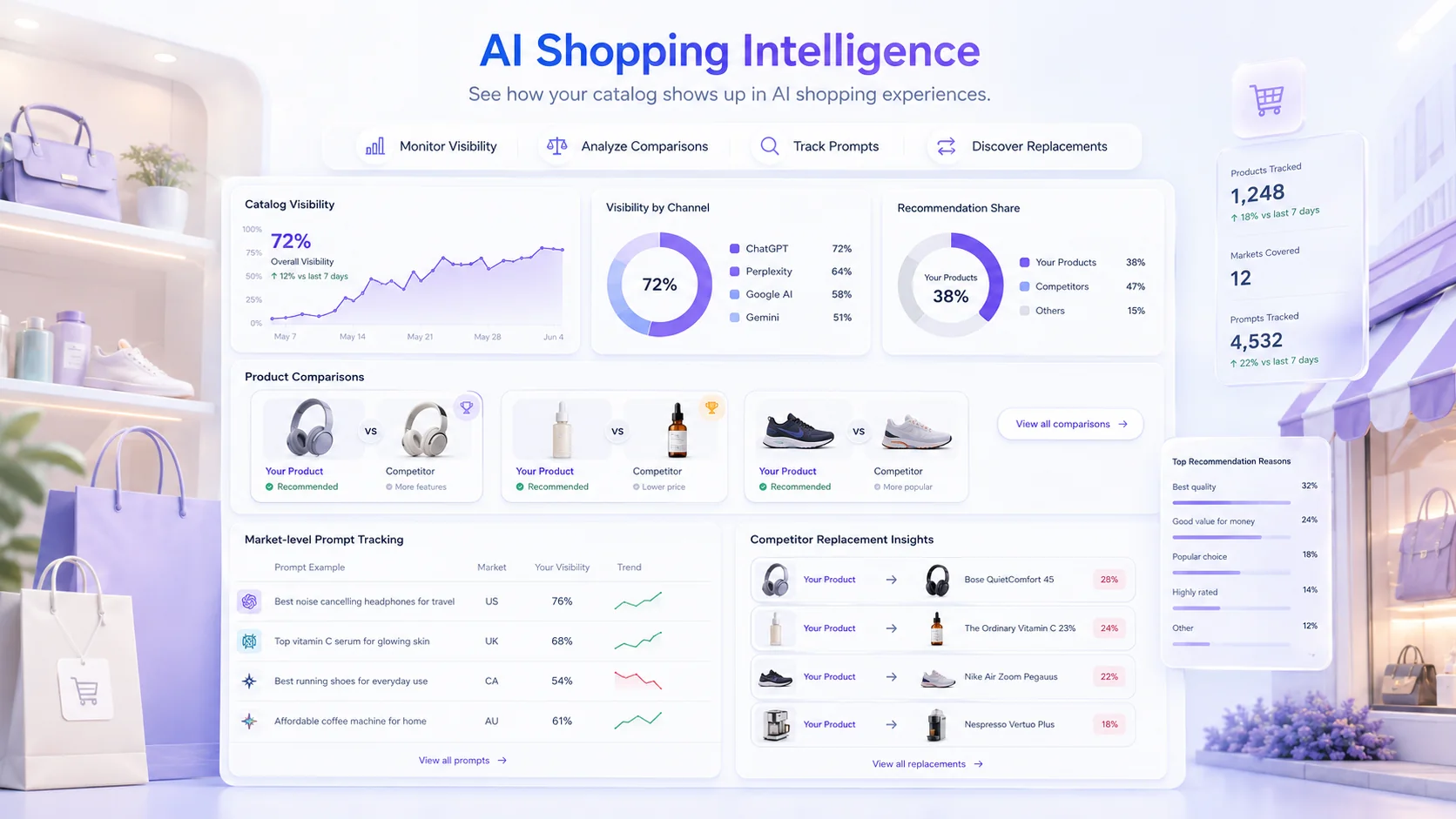
The ecommerce visibility chain
Names, variants, specifications and current product context.
Product, category, comparison and guide pages connected clearly.
Real questions segmented by need, audience, budget and market.
Product inclusion, position, rationale, competitors and sources.
Brand site, retailer, marketplace or no actionable destination.
One dataset, several teams
The same recommendation loss can mean different work for merchandising, content, and brand teams. A shared evidence layer prevents disconnected fixes.
See which products enter AI shortlists and which attributes define the category.
Inspect product and retailer visibility across high-intent shopping questions.
Connect missing recommendations with product, category, comparison, and guide content.
Find inaccurate descriptions and weak positioning before they become repeated narratives.
Prioritize prompt clusters and products with meaningful commercial relevance.
Turn repeated product-information gaps into useful, answer-ready pages.
Prioritize the catalog
Start with hero products, strategic categories, high-margin offers, launches, and products repeatedly displaced by competitors. Build broader coverage only after the initial prompt set produces useful decisions.
Commerce data foundation
Treat the catalog, product page, and supporting evidence as one system. If identifiers, variants, price, or availability disagree across them, adding more promotional copy only makes the product harder to verify.
Stable product IDs, titles, brand and category, variants, images, price, availability, and seller information.
Complete product facts, intended use, comparisons, policies, structured data, and a clear canonical destination.
Documentation, reviews, category guides, editorial comparisons, retailer records, and other public corroboration.
Large stores should not begin by monitoring every SKU against every imaginable prompt. Start with products where a visibility change can produce a commercial decision.
Protect products already responsible for meaningful demand.
Establish a baseline before and after a new product enters the market.
Focus effort where a qualified recommendation has greater value.
Avoid optimizing products that cannot fulfill demand.
Target prompt clusters where another SKU consistently replaces yours.
Correct products that appear with wrong specifications, fit, or availability.
| Owner | Reviews | Typical action |
|---|---|---|
| Merchandising | SKU losses, variants, inventory, product positioning | Correct catalog relationships and assortment priorities |
| Ecommerce | PDP completeness, price, availability, policies, conversion path | Improve product detail and commercial consistency |
| SEO and content | Citations, comparisons, missing buyer questions | Create or update decision-support content |
| Feed operations | Identifiers, titles, images, attributes, feed errors | Repair and enrich product records |
| Brand and legal | Inaccurate claims or unsupported positioning | Approve factual corrections and evidence |
Related intelligence
Common questions
Track recurring product-discovery and comparison prompts, then record recommended products, competing brands, answer framing, citations, and retailer destinations by market.
Not necessarily. Start with commercially important categories, hero products, priority audiences, and recurring buyer needs. Expand product-level coverage where it supports a real decision.
Ecommerce, merchandising, SEO, GEO, content, brand, and growth teams can use the same evidence for different actions, from product facts to comparison content.
Yes. Comparing AI answers and competitor recommendations can reveal missing product attributes, use cases, comparisons, and buyer questions that deserve clearer content.
Move from assumptions to recurring evidence
Monitor buyer prompts, product recommendations, competitors, citations, and shopping visibility across supported AI platforms.