
Identity
Exact product and brand name, model, category, variant relationships, and canonical page.
Make every important product easier to identify, compare, verify, and recommend. The objective is clear product truth and useful buyer context—not keyword repetition.
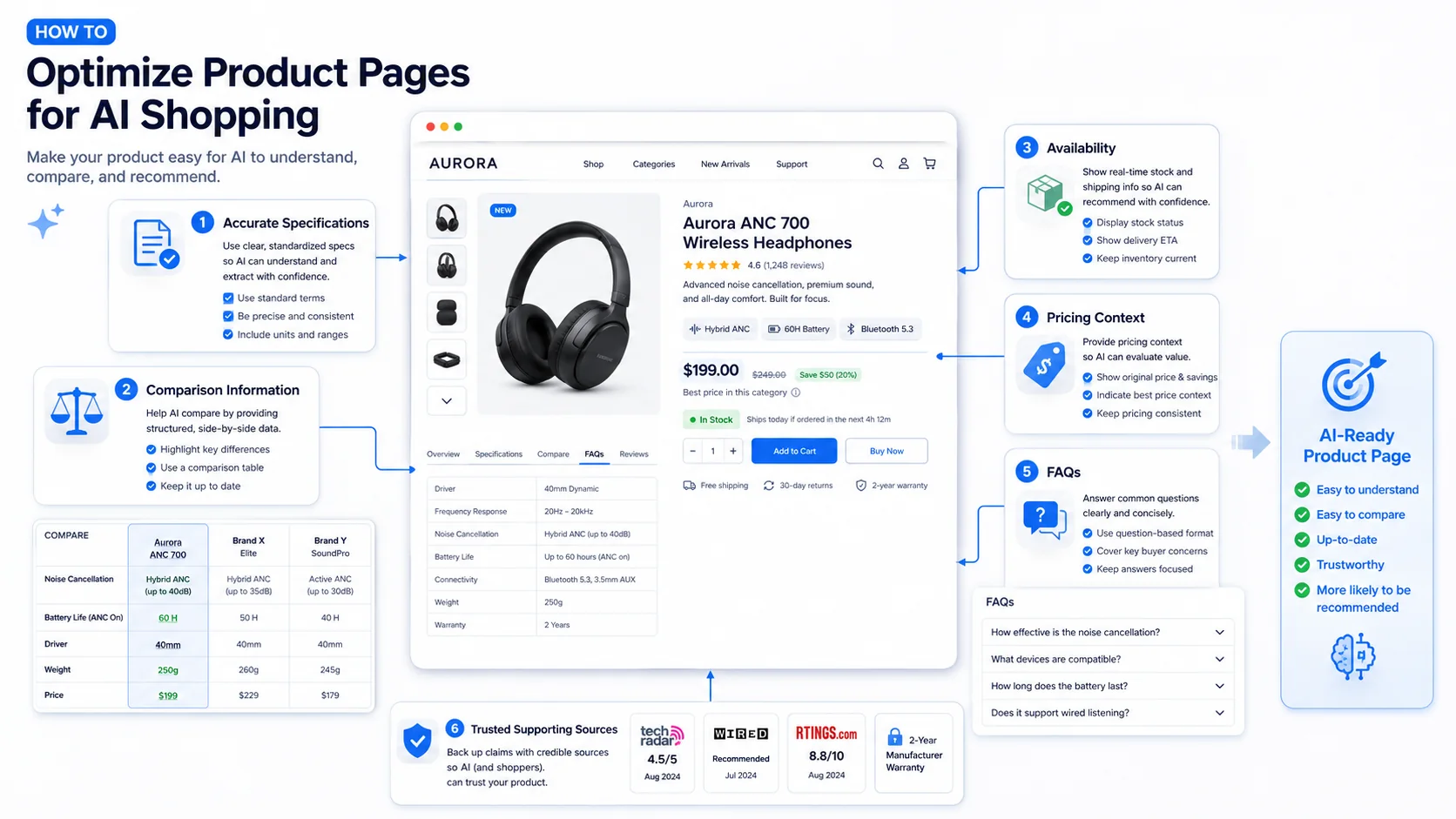
Six information layers
If the identity and facts are weak, adding more editorial content will not solve the underlying ambiguity.
Exact product and brand name, model, category, variant relationships, and canonical page.
Who it serves, the problem it solves, the situations where it is a strong choice, and important limits.
Materials, dimensions, compatibility, performance attributes, care, warranty, and other verifiable details.
Comparisons, alternatives, trade-offs, use cases, and plain-language explanations of technical attributes.
Current availability context, seller identity, pricing context, shipping, returns, and relevant policies.
Reviews, documentation, category pages, guides, comparisons, and trustworthy external references.
Weak product page
Answer-ready product page
Optimization sequence
Use real prompt outcomes and competitor evidence to decide what information is missing. A blanket rewrite can remove useful specificity or create unsupported claims.
Run relevant shopping prompts and classify current product outcomes.
Inspect winning products, answer rationales, sources, and retailer context.
Update the highest-value missing facts and buyer decision content.
Check page rendering, consistency, accessibility, and structured data accuracy.
Compare recurring prompt outcomes and document what changed.
Feed and page alignment
Product discovery systems can draw from structured catalog records and the public product detail page. The feed should make the item unambiguous and commercially current. The page should explain why it fits a use case, what trade-offs it carries, and where the facts come from. Neither layer compensates reliably for contradictions in the other.
| Weak field | Useful replacement | Why it helps buyers |
|---|---|---|
| “Premium lightweight design” | “223 g in men’s size 9 with a 36 mm heel stack” | Turns a claim into comparable facts. |
| “Perfect for everyone” | “Designed for neutral runners doing daily and tempo sessions” | Defines audience and intended use. |
| “Best-in-class cushioning” | Foam type, firmness, stack, ride character, and known trade-offs | Supports a reasoned comparison. |
| “Available in many options” | Explicit size, color, material, and package variant relationships | Prevents variants from becoming separate ambiguous products. |
| “Easy returns” | Return window, condition requirements, fees, and policy link | Makes the merchant proposition verifiable. |
A well-written page still fails if important facts are inaccessible, duplicated, stale, or contradictory.
Related intelligence
Common questions
A useful page gives clear product identity, factual specifications, buyer fit, trade-offs, variants, availability context, supporting policies, and internally linked comparison or guide content.
No. Write clear, useful content for buyers. Structured organization and precise facts help both people and retrieval systems understand the product.
FAQs can clarify recurring questions when they contain genuine, page-visible answers. They should complement the core product information rather than hide essential facts.
Track a stable set of relevant shopping prompts before and after meaningful updates, while recognizing that answer variation means one run is not conclusive.
Move from assumptions to recurring evidence
Monitor buyer prompts, product recommendations, competitors, citations, and shopping visibility across supported AI platforms.