
Recommendation rate
Inclusion
How often your product is recommended across eligible shopping answers.
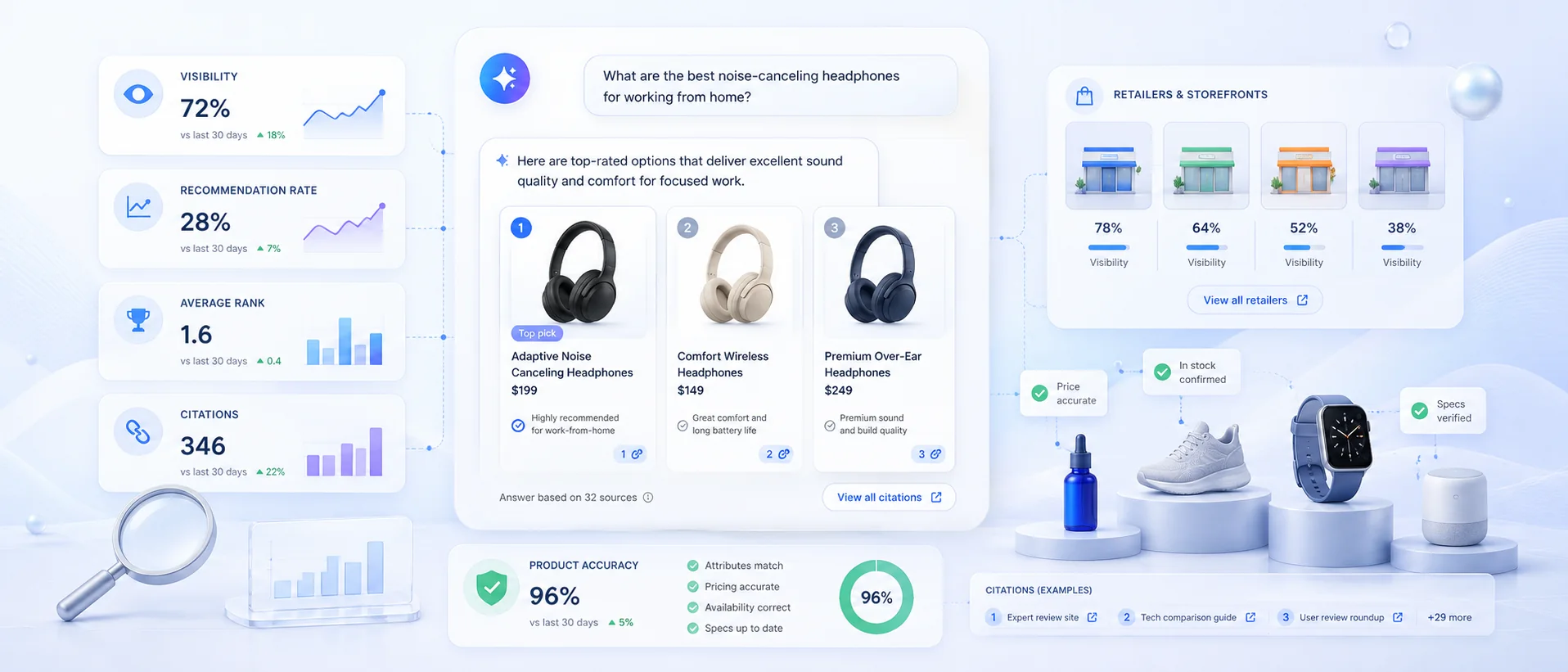
Visibility is more than a mention. It captures whether your products enter the shortlist, where they rank, what AI says about them, which sources support the answer, and where the shopper is sent next.
A precise definition
AI shopping visibility is the measurable presence of a product in AI-assisted discovery and comparison. It should never be reduced to one screenshot or one branded question.
A defensible program repeats the same buyer prompts across time, separates models and markets, and records both positive inclusion and the competitor that wins when you are absent.
Recommendation rate
Inclusion
How often your product is recommended across eligible shopping answers.
Average position
Placement
Where the product appears when the answer presents a ranked shortlist.
Shopping share of voice
Competition
Your share of tracked recommendations compared with competing brands.
Citation coverage
Evidence
The sources an answer relies on when describing or comparing the product.
Retailer destination
Purchase path
Whether buyers are directed to your site, a marketplace, or another seller.
Product accuracy
Integrity
Whether specifications, price context, availability, and positioning are correct.
Measurement model
The question has genuine product-discovery or buying intent.
Your product is included, excluded, or replaced by a competitor.
Sources, product facts, and comparisons shape the recommendation.
The answer sends the shopper to your site, a retailer, or nowhere.
The practical rule
Track a stable prompt set, count eligible answers, record your inclusion and position, then segment by platform, product, category, market, and buyer need. That produces a trend you can improve instead of a collection of anecdotes.
Where visibility comes from
A product can be technically available online and still be difficult to recommend. Shopping systems need to identify the exact item, understand who it suits, verify current commercial facts, and find enough evidence to compare it with alternatives. Those facts may come from a merchant feed, the product detail page, structured data, retailer listings, manuals, reviews, or editorial comparisons.
Treat those surfaces as one product record. A feed with a precise identifier but a vague landing page creates uncertainty. A detailed page paired with stale price or availability data creates a different kind of uncertainty. Strong visibility comes from agreement between the catalog, the page, and the sources that describe the product elsewhere.
This is why AI shopping work should sit between merchandising, product data, SEO, and brand teams. No single team owns every input that affects whether a model can confidently place a product in a buyer’s shortlist.
A measurement dictionary
Define the denominator before publishing a visibility score. A percentage without the prompt set, markets, platforms, and date range behind it cannot be compared over time.
| Metric | Calculation | What it reveals | Common mistake |
|---|---|---|---|
| Recommendation rate | Answers recommending the product ÷ eligible answers | Whether the product enters buying conversations | Counting branded prompts that almost guarantee a mention |
| Average position | Sum of observed positions ÷ ranked appearances | Prominence within shortlists and cards | Treating an unranked narrative mention as position one |
| Shopping share of voice | Brand recommendations ÷ all tracked brand recommendations | Competitive ownership of the monitored category | Comparing brands across different prompt sets |
| Direct-link share | Brand-domain destinations ÷ all destinations for the product | How much visible demand reaches your store | Assuming product visibility automatically means direct traffic |
| Accuracy rate | Correct observed facts ÷ facts checked | Risk from stale or conflicting product information | Reviewing only the product name and ignoring variants or availability |
Interpretation matters
Recurring inclusion, position, recommendation language, merchant routing, cited evidence, factual errors, and the rivals that replace you.
The private user prompt behind every visit, the internal ranking weights of a model, or that one content change caused a recommendation without controlled before-and-after measurement.
Related intelligence
Focus specifically on ChatGPT product recommendations and merchant paths.
Read guideBuild a recurring measurement system for products and competitors.
Read guideStrengthen the product facts and comparison context AI systems can use.
Read guideCommon questions
AI shopping visibility measures whether and how often a product or brand appears when an AI system answers product-discovery, comparison, and buying-intent questions.
No. A search ranking is a position in a list of links. AI shopping visibility concerns inclusion, recommendation position, answer framing, cited sources, and where the buyer is sent.
Measure category, problem, comparison, attribute, budget, audience, and local-market prompts. Branded prompts alone cannot show whether new buyers discover you.
Yes. It may appear rarely, rank below competitors, be described inaccurately, or link buyers to a marketplace instead of the brand website.
Move from assumptions to recurring evidence
Monitor buyer prompts, product recommendations, competitors, citations, and shopping visibility across supported AI platforms.