
Recommended
The answer actively selects the product for the buyer’s stated need.
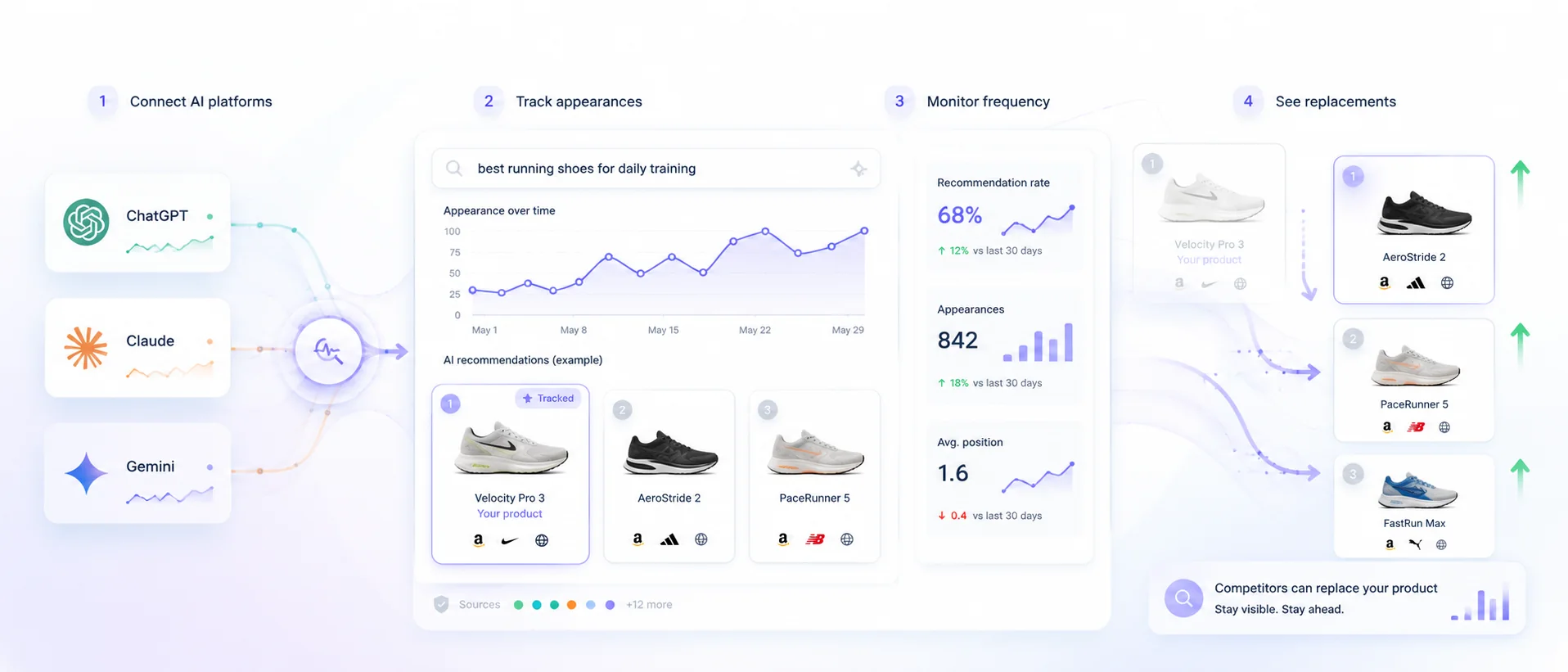
Recommendation tracking shows whether AI considers a product a real answer to the buyer’s need, how often that happens, and which competitor wins when it does not.
Outcome taxonomy
Counting every appearance as a recommendation inflates visibility. Classify the answer according to the commercial role the product actually plays.
The answer actively selects the product for the buyer’s stated need.
The product appears among viable options but is not framed as the clear choice.
The product is named without a meaningful buying recommendation.
A competitor satisfies the prompt while the monitored product is absent.
The product appears, but important facts or positioning are wrong.
Recommendation history
A useful change log records when product pages, comparisons, availability, or supporting sources changed. Correlation is not proof of causation, but it gives teams a disciplined investigation path.
The competing product matches the stated audience, constraint, or use case more clearly.
The answer has stronger product facts, comparisons, citations, or retailer context to rely on.
The competitor presents a clearer current path to evaluate or purchase the product.
Recommendation ladder
Visibility becomes more commercially meaningful as a product moves from simple recognition to a qualified recommendation and then to a usable merchant destination. Tracking the ladder keeps teams from celebrating weak mentions as completed wins.
Not present in the answer
Named without buyer fit
Included as a viable option
Selected for the stated need
Given a clear relative position
Connected to a merchant path
“Competitor A appears often” is too broad to guide action. Record which competitor replaces which product for a specific need, audience, constraint, and market. The same rival may dominate budget prompts but disappear from durability or professional-use questions.
Useful replacement record
Prompt cohort → monitored SKU → outcome state → replacement SKU → stated reason → cited source → merchant destination → date.
Related intelligence
Common questions
It is the recurring measurement of which products appear in AI answers, how they are positioned, why they are selected, and which competitors appear for the same buyer questions.
It is an observation where a relevant prompt recommends a competing product while the monitored product is absent or positioned lower.
Both. Brand-level trends show overall share, while product-level tracking reveals which specific SKUs or offers drive the result.
History helps teams identify durable patterns, relate changes to updated product content, and prioritize the prompts where competitors repeatedly win.
Move from assumptions to recurring evidence
Monitor buyer prompts, product recommendations, competitors, citations, and shopping visibility across supported AI platforms.