
01
Define buyer-intent clusters
Group prompts by category, problem, comparison, feature, budget, audience, and market. This prevents one prompt type from dominating the result.
The goal is not to collect screenshots. It is to create a repeatable dataset that shows which products win, why they win, and what changes.
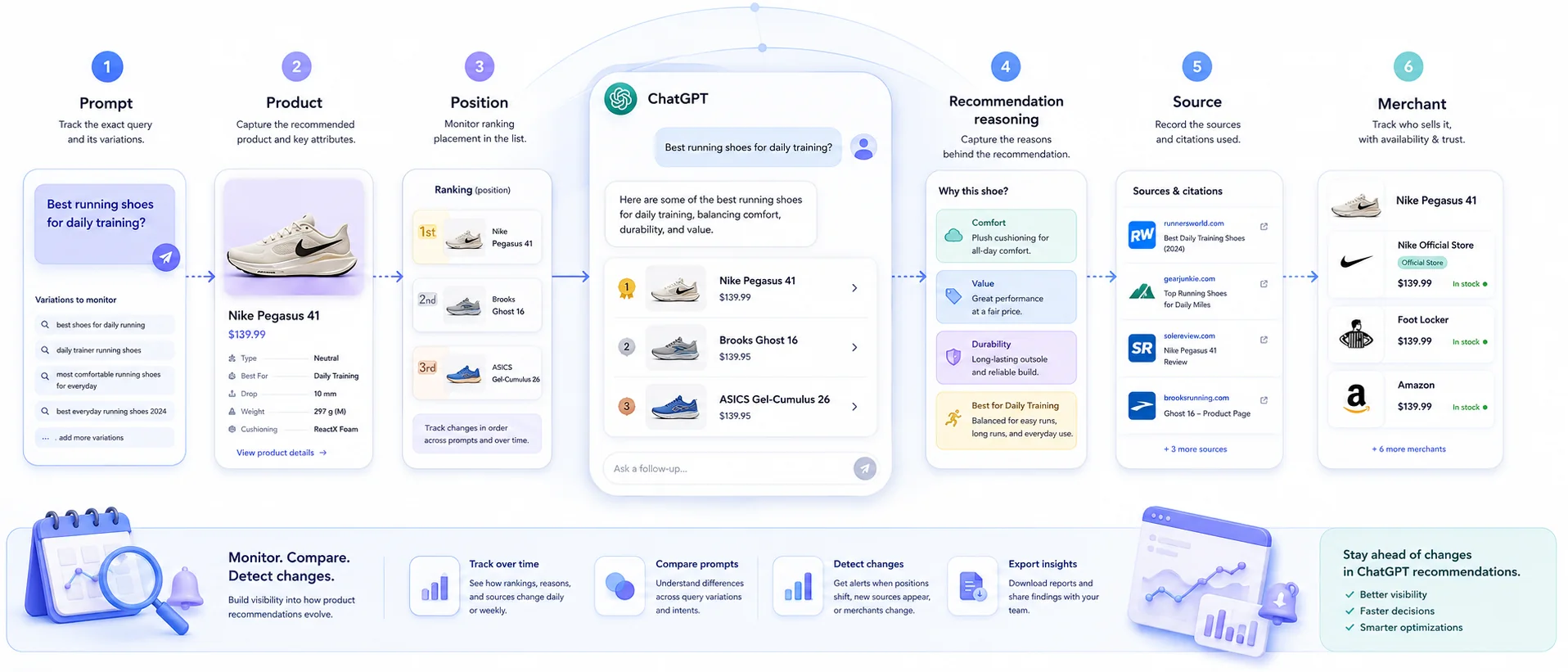
Six-step workflow
Group prompts by category, problem, comparison, feature, budget, audience, and market. This prevents one prompt type from dominating the result.
Keep a stable baseline set. If wording changes, preserve the old version so the trend remains interpretable.
Record platform, market, language, date, and any context that may influence the response.
Capture every named product, relative position, stated reason, cited source, and merchant destination.
Separate recommended, mentioned, absent, inaccurate, and competitor-replaced outcomes.
Measure changes by product and prompt cluster, then connect meaningful movement to content or catalog updates.
Tracking specification
A recommendation count without context is easy to misread. These fields make every observation auditable and useful to ecommerce, content, and brand teams.
Do not merge these outcomes
A product mention, a qualified recommendation, a top-ranked product card, and a direct merchant link are different events.
Quality controls
Step zero: sampling
Choose prompts systematically so the benchmark represents the category. A hundred near-duplicate “best product” questions are less useful than a smaller set spanning real purchase conditions.
| Dimension | Examples | Why include it | Segmentation field |
|---|---|---|---|
| Intent | Discover, compare, replace, validate, buy | Separates early research from purchase-ready requests | intent_type |
| Need | Comfort, durability, speed, safety, compatibility | Tests the product claims that drive recommendation fit | need_cluster |
| Constraint | Budget, size, material, audience, location | Shows where product eligibility breaks down | constraint |
| Market | Country, language, currency, delivery region | Prevents global availability from masking local gaps | market |
| Product scope | Category, product family, model, variant | Allows SKU-level and portfolio-level reporting | product_scope |
| Competitive frame | Open category, named rival, alternative to | Reveals replacement patterns and comparison language | comparison_set |
Worked example
Suppose 40 monitored questions were eligible to produce product recommendations. Your product was recommended in 14 answers, ranked in 10 of them, and linked directly to your store six times.
35%
Recommendation rate
14 ÷ 40
2.4
Average ranked position
24 position points ÷ 10
43%
Direct-link share
6 ÷ 14
Numbers tell you where to investigate. The log explains what changed between runs.
Cadence and variance
Generative answers vary. Run the same controlled prompt set on a recurring schedule and compare rolling periods rather than reacting to a single execution. Preserve the model, market, language, and prompt text so the runs remain comparable.
Use more frequent checks for volatile categories with changing prices or stock. A slower cadence can work for stable B2B products, provided the same questions continue to represent how buyers evaluate the category.
When a result changes, inspect the product facts, sources, merchants, and competitor set together. A visibility gain caused by an unavailable product being removed is different from a gain caused by stronger product evidence.
Related intelligence
Common questions
Yes. A monitoring workflow can run a stable set of shopping prompts repeatedly and store products, brands, positions, sources, merchants, and answer context for comparison over time.
Use a recurring cadence appropriate to the category and plan. The important requirement is consistency: compare the same prompt cluster over time rather than changing every question each run.
Record the prompt, timestamp, platform, market, products named, ordering or position, recommendation rationale, citations, merchant links, and competing products.
No. Results can vary with wording and context. Use controlled prompts and repeated observations to measure patterns rather than claiming one universal rank.
Move from assumptions to recurring evidence
Monitor buyer prompts, product recommendations, competitors, citations, and shopping visibility across supported AI platforms.