Diagnostic guide

Why your products do not appear in ChatGPT shopping

Absence is usually a chain problem, not one missing keyword. Diagnose access, product truth, buyer fit, external evidence, and prompt coverage in that order.

Run the six-part diagnosis

Do not assume

“We rank in Google, so ChatGPT should recommend us.”

Search visibility can help discovery, but AI shopping answers also depend on product clarity, query fit, supporting evidence, merchant information, and the options available for that request.

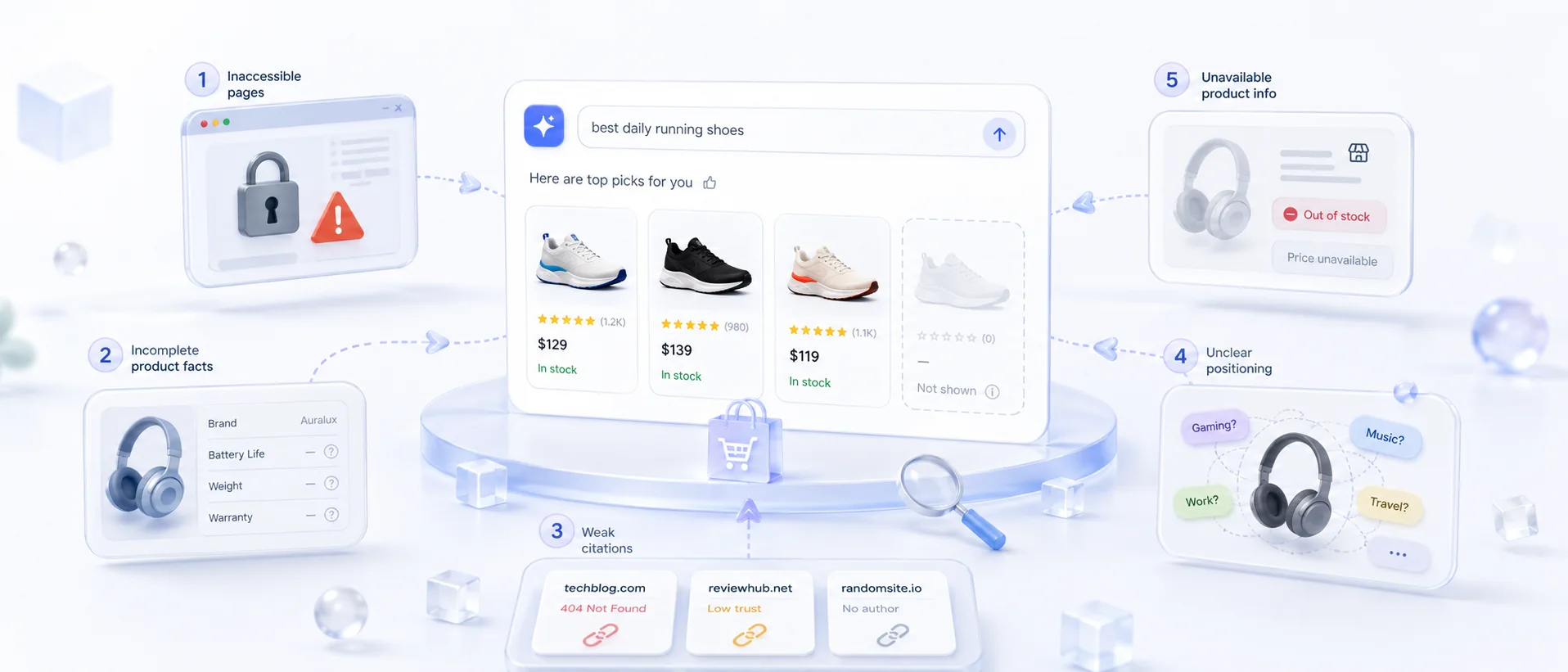
Diagnostic map showing causes that keep products out of ChatGPT shopping recommendations

Find the broken link

Six causes, with a test and a specific response

01

The page is not reliably accessible

Your product is absent even from highly specific prompts that match it closely.

What to check

Confirm the product and category pages are public, crawlable, internally linked, and return stable successful responses.

What to fix

Repair access, internal discovery, canonicalization, and page reliability before changing copy.

02

Core product facts are incomplete

Competitors are selected for attributes your product supports but does not explain clearly.

What to check

Compare dimensions, variants, materials, compatibility, use cases, warranty, price context, and availability.

What to fix

Add factual, consistent specifications and explain what each attribute means for the buyer.

03

The buyer fit is ambiguous

ChatGPT describes the product but does not choose it for a specific audience or constraint.

What to check

Look for direct answers to who it is for, when to choose it, trade-offs, and alternatives.

What to fix

Add audience, problem, comparison, and use-case language without making unsupported claims.

04

Other sources carry more authority

The same reviews, retailers, or editorial pages repeatedly support competing products.

What to check

Inspect citations and merchant sources present in the winning answers.

What to fix

Improve accurate third-party coverage and create owned pages worthy of being used as supporting evidence.

05

Information conflicts across the web

Names, specifications, pricing context, or availability differ between your site and retailers.

What to check

Audit the brand site, product feeds, major retailers, support pages, and current documentation.

What to fix

Reconcile the product truth layer and retire outdated facts where you control them.

06

You are testing the wrong questions

Branded prompts work, but non-branded shopping prompts reveal no discovery visibility.

What to check

Test category, comparison, problem, budget, feature, and local-market prompt clusters.

What to fix

Measure real buyer questions repeatedly and prioritize gaps with commercial intent.

Fix in the right order

01

Access

02

Accuracy

03

Buyer fit

04

Authority

Do not begin with broad content production if the product page cannot be accessed or its facts conflict. Resolve foundational failures first, then strengthen comparison context and external evidence.

The silent blockers

Approved and indexed does not mean recommendable

Some catalog problems trigger a visible error. Others simply make the product a weak match for natural-language shopping questions. The second group is harder to notice because nothing appears technically broken.

Generic title

“Women’s shoe” identifies a category but not the material, support type, intended activity, model, or distinguishing variant.

Missing product identifiers

Unstable IDs, absent GTINs where they exist, or inconsistent model names make it difficult to reconcile the same item across feeds, pages, and retailers.

Unresolved variants

Color, size, capacity, compatibility, or bundle differences are not connected to a parent product and cannot be matched to constrained questions.

Boilerplate description

Repeated brand copy says little about the use case, measurable specifications, limitations, or who should choose the product.

Conflicting commercial facts

The price, currency, stock state, condition, or shipping context differs between the feed, structured data, page, and retailer listing.

Thin evidence

The page makes a claim such as “best for sensitive skin” without ingredients, test context, certifications, usage guidance, or trustworthy external support.

A practical triage

What to inspect before rewriting any content

Catalog diagnostics

Check disapprovals, identifiers, category mapping, image access, variant fields, and landing-page URLs.

Live consistency

Compare feed price and availability with visible page copy and Product/Offer structured data.

Machine access

Request the exact product URL, images, and supporting documents without cookies, scripts, or an account.

Recommendation benchmark

Run several non-branded prompts and record the products, reasons, merchants, and sources that win instead.

The winning competitor is part of the diagnosis. If its title resolves a specific use case, its page exposes a missing specification, or its merchant data is fresher, you have a concrete repair target. “Create more content” is not a diagnosis.

Three fixes that often waste time

Adding keywords everywhere

Shopping questions are constrained by facts and fit. Repetition does not repair missing specifications, unavailable variants, or conflicting prices.

Publishing self-serving “best” lists

A page that ranks your own product first may be cited as a source while another product receives the recommendation. Citation and selection are separate outcomes.

Changing everything at once

If the feed, page, FAQ, and external content all change together, you cannot identify what improved the result. Fix foundations, rerun the benchmark, then expand.

Common questions

What teams ask about AI shopping

Why does ChatGPT recommend competitors but not my product?+

Common causes include weak retrieval access, incomplete product details, unclear buyer fit, stronger competitor evidence, inconsistent information, or insufficient support from trusted sources.

Will adding product schema guarantee a ChatGPT recommendation?+

No. Structured data can improve clarity, but it does not guarantee inclusion. Product fit, source quality, public information, availability, and answer context also matter.

Can an out-of-stock product disappear from shopping answers?+

Availability and merchant information can affect whether a product is useful for a current buying request. Keep availability and product facts consistent across relevant sources.

How do I identify the real cause?+

Test accessibility, compare your product facts with winning products, inspect cited sources, review the recommendation rationale, and repeat the same prompts after each meaningful fix.

Move from assumptions to recurring evidence

See where your products appear in AI shopping answers

Monitor buyer prompts, product recommendations, competitors, citations, and shopping visibility across supported AI platforms.