
Executive movement
What improved, declined, or remained stable since the previous reporting period.
Give ecommerce clients a recurring view of product recommendations, competitor wins, citations, and the actions most likely to close meaningful visibility gaps.
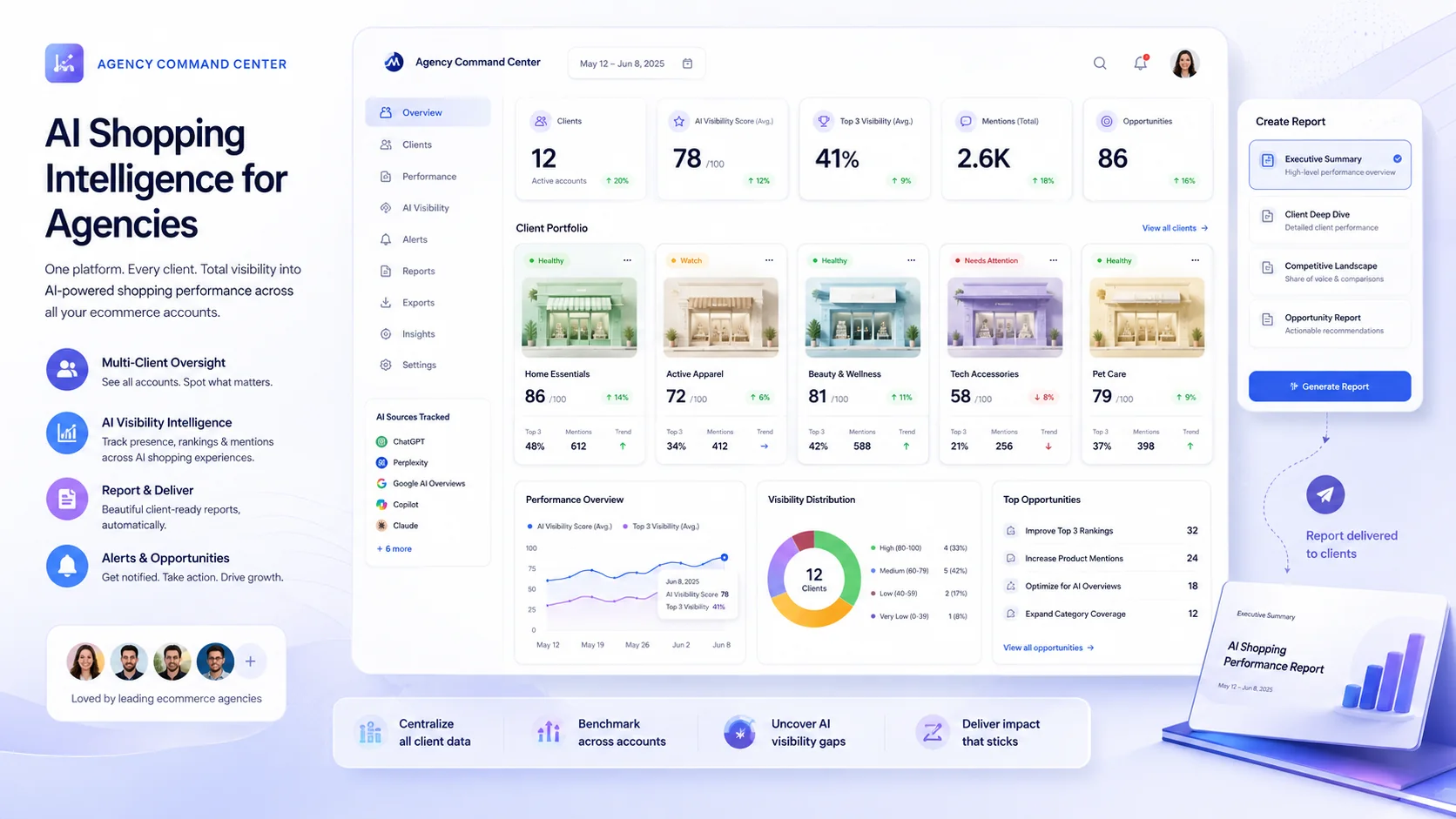
Report architecture
Avoid a dashboard dump. Lead with movement and decisions, then preserve the prompt-level evidence for specialists who need to investigate.
What improved, declined, or remained stable since the previous reporting period.
Products recommended, shortlisted, missing, replaced, or described inaccurately.
Brands and products occupying the same high-intent recommendation sets.
Citations, retailers, and external pages influencing how products are framed.
Prioritized page, content, and product-information improvements with clear owners.
Recurring delivery model
Define client products, competitors, markets, prompt clusters, and baseline classifications.
Run the agreed prompt set on its recurring schedule and preserve historical outcomes.
Explain recommendation movement, source patterns, inaccuracies, and competitor replacement.
Turn validated gaps into client-approved product, comparison, and content improvements.
The strongest agency deliverable ties every recommendation trend to evidence, business relevance, a responsible owner, and a measurable follow-up run.
Client setup standard
Standardize the measurement frame, not the client’s market. Each account needs an explicit product scope, prompt taxonomy, competitive set, languages, countries, merchant aliases, and reporting definitions before the first benchmark is presented.
Brands, product families, priority SKUs, retailers, markets, and languages.
Category, problem, comparison, audience, budget, and branded shopping questions.
Agree what counts as mentioned, shortlisted, recommended, linked, inaccurate, or replaced.
Archive answers and explain what the initial metrics do and do not prove.
Connect each recurring loss to an owner, evidence, deadline, and verification run.
Recommendation, shortlist, and merchant-link rates by prompt cohort and market.
The SKUs gaining visibility and the competitors replacing priority products.
Incorrect specifications, positioning, price, availability, or seller information found in answers.
Domains and page types repeatedly cited around the client and competing products.
Catalog, PDP, feed, content, and evidence changes shipped during the period.
Prioritized work with an owner, expected evidence, and a future verification date.
Do not imply that one content change caused an answer movement or that a tracked prompt represents all customer behavior. Use controlled cohorts, recurring runs, transparent definitions, and trend language.
Related intelligence
Common questions
Agencies can build recurring services around prompt coverage, product and competitor visibility, citation analysis, content gaps, and prioritized recommendations.
Market and language-specific prompts should be separated so reports reflect the client’s actual operating context rather than blending unrelated answers.
Include coverage, recommendation share, notable product gains and losses, competitor movement, source patterns, accuracy issues, and the next actions tied to evidence.
Use recurring prompt sets and consistent classifications. Compare recommendation outcomes before and after meaningful changes without presenting correlation as guaranteed causation.
Move from assumptions to recurring evidence
Monitor buyer prompts, product recommendations, competitors, citations, and shopping visibility across supported AI platforms.