
MCPCMS Automation
MCP Scoped Approvals vs Autonomous CMS Publishing Guide
Compare MCP scoped action approvals with fully autonomous CMS publishing workflows to eliminate brand safety errors and turn AI search into pipeline ROI.
João Cotralha7 min read
The B2B CMS Publishing Dilemma: Speed vs Risk
B2B demand generation teams face an operational trade-off when scaling content pipelines: publishing volume drives organic search footprint, but unverified content risks severe brand damage and indexing penalties. Automating the workflow from keyword research to live blog deployment promises massive time savings, yet handing total control to artificial intelligence frequently leads to published hallucinations, incorrect pricing mentions, and off-brand positioning.
To navigate this challenge, content engineers and growth marketers evaluate four distinct deployment architectures: fully autonomous CMS publishing, prompt-constrained AI publishing, Model Context Protocol (MCP) scoped action approvals, and manual AI drafting with traditional publishing. Each strategy balances speed, brand safety, and technical complexity differently depending on company size and risk tolerance.
- Fully Autonomous CMS Publishing runs completely hands-off from topic discovery to live URL pushing, maximizing generation volume while accepting high operational risk.
- Prompt-Constrained AI Publishing attempts to enforce guardrails using system prompt instructions, offering simple configuration that remains vulnerable to security bypasses.
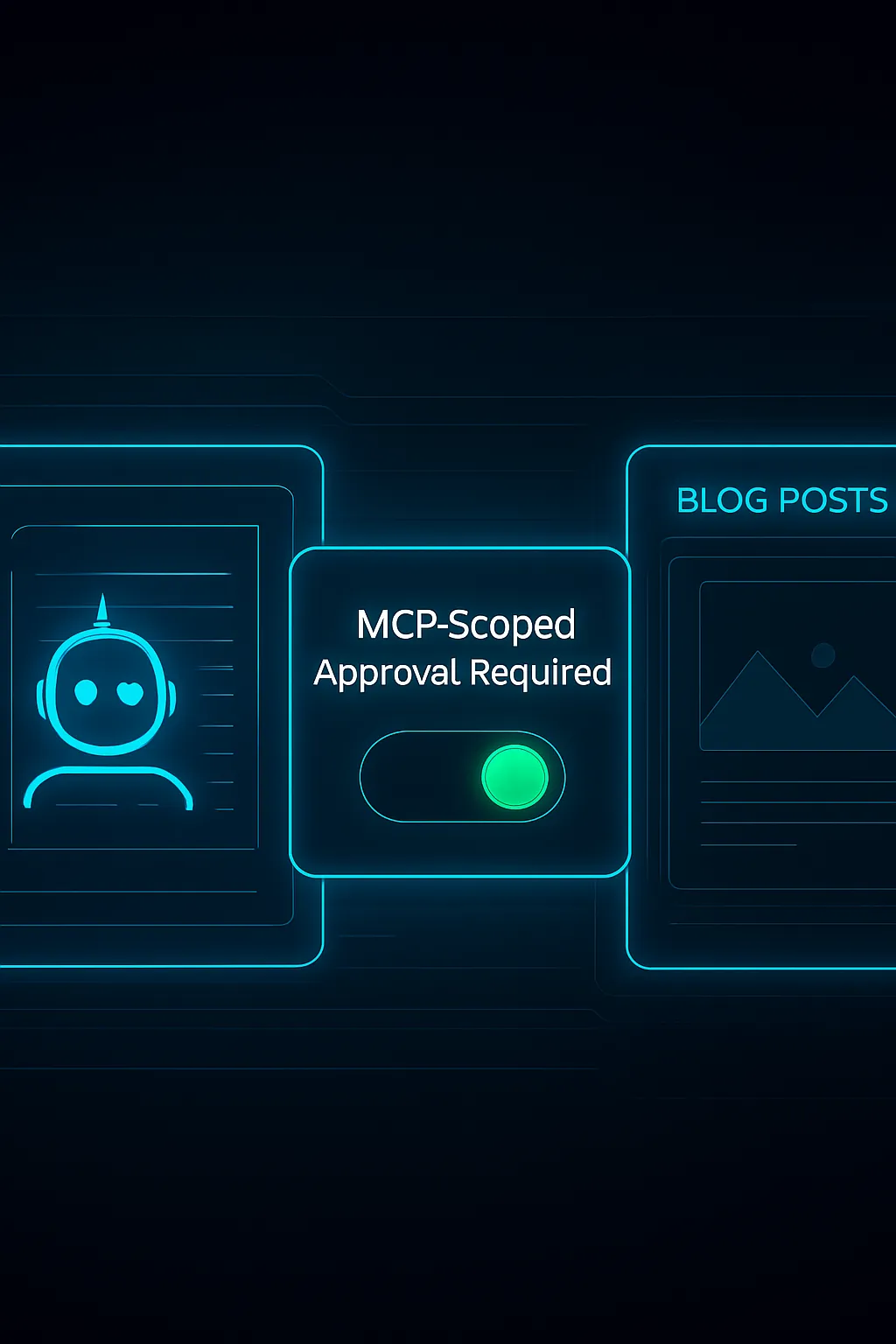
- MCP Scoped Action Approvals combines automated drafting and staging with explicit tool boundaries, requiring human authorization before any production database modification.
- Manual AI Drafting and Publishing keeps content creation isolated in external editors, relying on traditional human copy-pasting and manual editorial scheduling.
Approach 1: Fully Autonomous CMS Publishing
Fully autonomous publishing connects an AI text generator directly to live content management systems via write-enabled APIs. In this operational model, background jobs run on schedule to research topics, generate full articles, insert images, format markdown, and toggle posts to published status without human intervention.
This methodology works best in high-volume affiliate sites, secondary directory operations, or unbranded experimental domains where scale is prioritized above individual asset accuracy. When managing hundreds of localized program pages or routine updates where errors incur minimal financial risk, full autonomy minimizes labor overhead.
However, the main limitation of fully autonomous publishing is its complete vulnerability to hallucinated facts, broken links, and brand voice drift. In B2B environments where target buyers inspect pricing claims and feature sets, an unverified post stating incorrect technical specs directly undermines buyer trust and sales pipeline.
Approach 2: Prompt-Constrained AI Publishing
Prompt-constrained AI publishing attempts to build safety guardrails by instructing the underlying large language model not to publish under certain conditions. Marketers write detailed system instructions directing the model to evaluate its own draft, verify claims, and refrain from calling the publish API if confidence scores fall below set thresholds.
This approach works best for small teams seeking a lightweight compromise without setting up dedicated authorization infrastructure. It allows marketers to experiment with automated publishing workflows using basic LLM tool-calling capabilities while attempting to restrict live deployment through plain English prompts.
Its critical limitation lies in the fundamental insecurity of prompt-level constraints. As security analyses published on composio.dev demonstrate, prompt constraints cannot guarantee permission enforcement because context injection and adversarial inputs can easily bypass text-based instructions. Relying on an LLM to self-regulate its API privileges creates a fragile system prone to unintended live pushes.
Approach 3: MCP Scoped Action Approvals
MCP scoped action approvals separate discovery and drafting tools from live execution endpoints using Model Context Protocol specifications. Under this architecture, AI agents operate autonomously within sandboxed staging databases to research, write, format, and audit content, but trigger mandatory, human-in-the-loop consent approvals before touching production systems.
This workflow works best for mid-market and enterprise B2B SaaS organizations running high-velocity content engines across multiple distribution channels. By establishing rigid protocol-level permissions, growth teams scale content output while guaranteeing that zero unvetted words reach live domain environments.
Modern content operations require agent-ready CMS frameworks that separate read capabilities from live write actions, as detailed in vanitech.com.au. Supported actions need a separate permission before altering live CMS instances, ensuring that agents can autonomously build draft posts while remaining incapable of publishing independently. Marketers reviewing workflows can inspect content inside an approval mode prior to distribution.
The primary limitation of MCP scoped approvals is the initial integration requirement. Technical teams must set up an MCP server, define distinct tool schemas for read and write endpoints, and configure authentication flows within their team operations software.
Approach 4: Manual AI Drafting and Publishing
Manual AI drafting represents the traditional content creation pipeline updated with AI writing tools. Content writers use standalone interfaces to generate article drafts, manually review the text, copy it into a CMS editor like WordPress or Webflow, apply formatting, add metadata, and click publish.
This approach works best for early-stage startups, boutique advisory firms, and high-touch B2B brands producing low-volume, highly specialized thought leadership. When publishing cadence is limited to one or two deep pieces per month, manual handling adds minimal operational delay while preserving human oversight.
The main limitation is poor operational velocity and high manual overhead. Scaling content output across multiple verticals or maintaining consistent search engine refresh rates becomes difficult when every asset requires manual transfer, formatting fix, and metadata entry.
Strategy Comparison Matrix
| Publishing Approach | Security & Permission Boundary | Editorial Control & Compliance | Scalability & Operations | Risk of Hallucination Pushed Live |
|---|---|---|---|---|
| Fully Autonomous Publishing | Zero-trust bypass | None (Machine-driven) | Maximum operational speed | Critical risk |
| Prompt-Constrained Publishing | Soft prompt-level limits | Low (Injection vulnerable) | High speed | Moderate-high risk |
| MCP Scoped Action Approvals | Architectural tool scoping | High (Mandatory consent step) | High speed with safety | Minimal risk |
| Manual Drafting & Publishing | File-level isolation | Total manual oversight | Low (Manual bottle-necks) | Zero AI live push risk |
Recommendation by Marketing Situation
Enterprise & High-Compliance B2B SaaS
For enterprise SaaS brands operating under strict regulatory compliance or selling into security-conscious buyers, MCP Scoped Action Approvals is the clear recommendation. Granting AI agents unrestricted write access to live production databases exposes the organization to severe brand and compliance liabilities. MCP scoped architecture guarantees that all automated work occurs in staging environments while retaining human sign-off for canonical live URL releases.
Rapidly Scaling Growth Teams
Growth marketing teams tasked with building topical authority across hundreds of long-tail search queries should implement MCP Scoped Action Approvals over fully autonomous pipelines. Staging automated content via structured protocol tools allows editors to review five to ten pre-built drafts in the time it usually takes to write one, maintaining high throughput without sacrificing editorial standards. Drafts generated across research pipelines can be routed directly into WordPress, Ghost, Wix or webhook endpoints for staging review.
Solo Founders and Micro-Marketing Teams
For solo founders managing limited resources, beginning with Manual AI Drafting transitioning into MCP Scoped Action Approvals offers the safest growth path. Starting manually ensures brand positioning remains focused, while upgrading to scoped tool approvals prevents operational bottlenecks as publishing demands increase. Avoid prompt-constrained auto-publishing to protect brand credibility.
How Model Context Protocol Enforces Staging-to-Production Safety
Model Context Protocol transforms website operations by providing open, standardized interfaces between intelligent assistants and web infrastructure, as explained by seosdesign.se. Rather than handing an AI model raw API keys that grant unrestricted administrative access, engineering teams expose discrete MCP tools designed for specific operations.
In an agent-ready content pipeline, tool permissions are explicitly segregated into two operational tiers:
- Read and Stage Tools (Unrestricted Execution): The AI agent calls endpoints to fetch search analytics, audit internal links, generate schema markup, write draft markdown, and push content into sandbox CMS databases.
- Production Publish Tools (Consent Enforced): The AI agent calls endpoints to toggle draft posts to published, alter domain redirects, or push updates to live production environments. These endpoints require explicit user confirmation through an authorization interface.
This architectural separation prevents model hallucinations or adversarial prompt injections from altering production sites. Even if an agent receives instructions to force-publish an incomplete draft, the underlying MCP client halts execution until an authorized user approves the payload.
Measuring Pipeline Impact and Search Engine Visibility
Automating content workflows aims to drive qualified pipeline and revenue. Uncontrolled publishing often results in low engagement, poor search engine indexation, and fast bounce rates, whereas controlled MCP publishing ensures high asset quality that translates into organic pipeline growth.
When evaluating automated publishing strategies, B2B performance marketers track three primary ROI metrics:
- Indexation Efficiency: The speed and percentage of published URLs indexed by modern search platforms. High-quality, human-approved posts index faster and maintain higher rankings than unedited AI output.
- Pipeline Conversion Rate: The ratio of organic content readers converting into qualified sales leads or demo requests. Scoped editorial reviews ensure clear calls-to-action, correct feature definitions, and accurate pricing tiers.
- Brand Equity & Accuracy: Protecting the organization from publishing contradictory or outdated product information that damages enterprise sales conversations.
By deploying MCP scoped action approvals, growth teams build high-velocity publishing pipelines that scale organic visibility while protecting brand integrity and driving pipeline performance.
Sources
External references for the statements in this article.
Stay visible as AI search evolves
Practical research on AI visibility, citations, crawler activity, shopping recommendations, and GEO strategy.
Useful insights only. Unsubscribe anytime.