
Diagnose a visibility drop
Ask which prompts, pages, countries, or assistants changed, then compare the current evidence with the previous period before deciding what to rewrite.
Live intelligence for AI-assisted SEO
The Model Context Protocol (MCP) is a standard way for compatible AI applications to discover and use external tools and data. For SEO and generative engine optimization, that means moving from copied exports to grounded questions about current rankings, citations, crawlers, and content.
Ask
Use natural language to frame the investigation you actually need.
Ground
Pull account-scoped evidence instead of trusting an unverified answer.
Act
Turn the finding into a page, technical, or measurement improvement.
The mental model
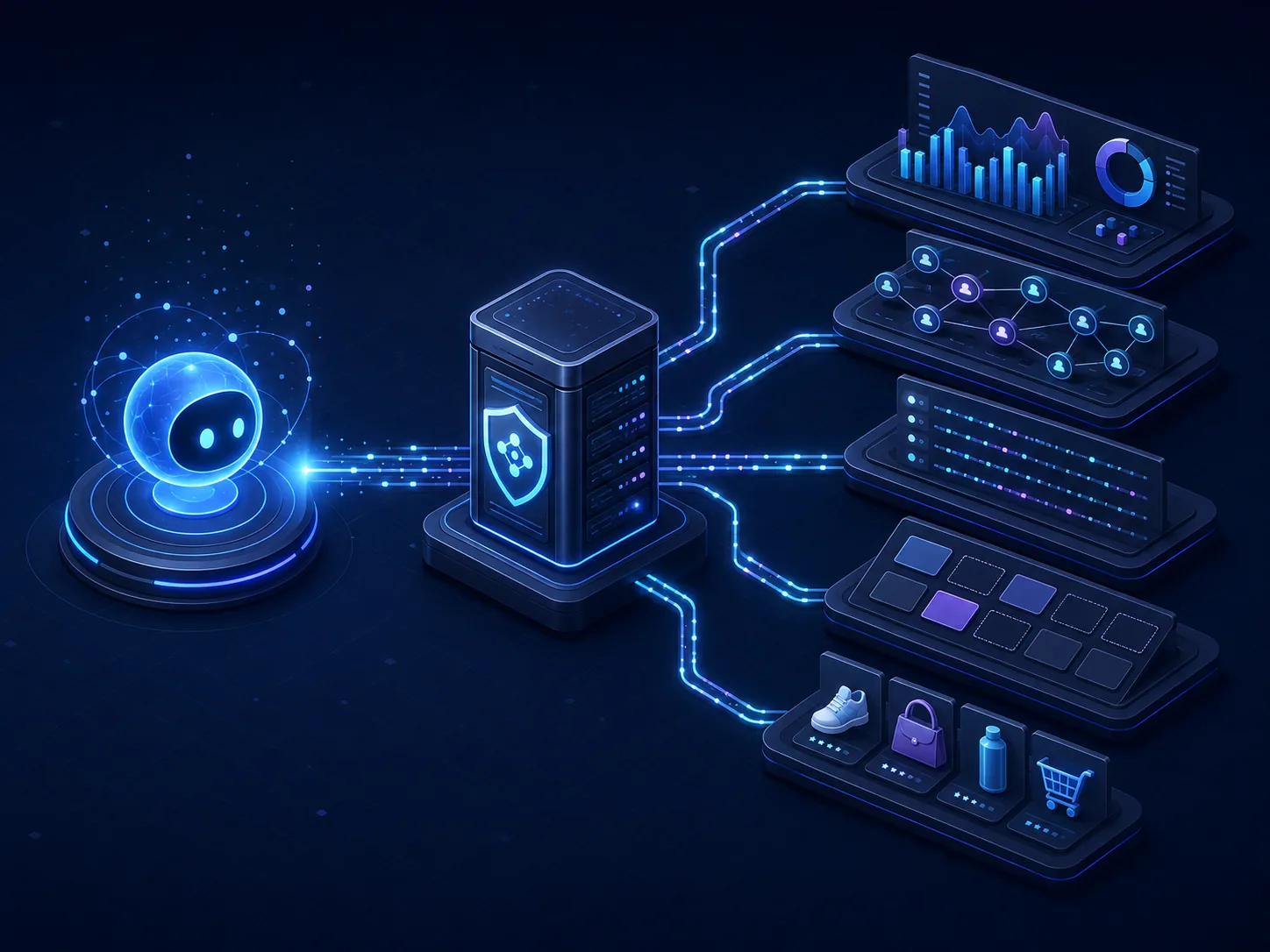
An AI host—such as an assistant, IDE, or agent runtime—connects to an MCP server through a client. The server describes the tools and resources it is willing to expose. The host can then select a relevant tool, pass a structured request, and show the returned evidence in the conversation.
That distinction matters for marketing teams. An MCP connection can make analysis faster and more repeatable, but it does not replace Search Console, analytics, crawl validation, editorial judgment, or the work of improving a page. The useful output is a traceable decision: what changed, why it matters, and what should happen next.
Host
Your AI assistant
Understands the question and presents the result.
MCP server
Brand Armor intelligence
Exposes approved, account-scoped tools and resources.
Live evidence returned
AI answers and citations · prompt trends · competitor comparisons · content gaps · crawler observations · shopping visibility
Choose the right layer
These tools overlap, but they solve different workflow problems. A dashboard is best for visual exploration; an API is best for deterministic integrations; MCP is best when an AI host needs to discover and call approved capabilities while keeping the investigation conversational.
| Layer | Best for | Example SEO question |
|---|---|---|
| Dashboard | Visual trends, filtering, and team review | Which pages gained AI citations this month? |
| API | Scheduled exports, custom products, and deterministic jobs | Send yesterday's prompt results into our warehouse. |
| MCP server | Contextual investigation inside an AI workflow | Why did our visibility fall for these commercial prompts in Germany? |
High-value workflows
“Give me SEO ideas” is too vague to produce dependable work. Strong MCP prompts contain a time window, market, page set, query or prompt set, and a requested decision. These are better starting points for an SEO team or agency.
Ask which prompts, pages, countries, or assistants changed, then compare the current evidence with the previous period before deciding what to rewrite.
Turn “we are mentioned but never cited” into an investigation: which claims are unsupported, which competitors are cited, and which source pages should be strengthened?
Combine query intent, existing rankings, AI answers, and crawl signals to separate a page that needs better evidence from one that needs a completely different search intent.
Use live crawler observations to check whether important pages are accessible, wasting crawl budget, blocked, or being requested in unexpected patterns.
Let an agency assistant pull the same account-scoped evidence behind a recommendation, so a report can show the query, source, page, and next action—not just a score.
Investigate whether product data, pricing, availability, and merchant proof are represented consistently across AI shopping journeys and recommendation prompts.
A safe operating model
The best first MCP connection is intentionally boring: narrow permissions, clear descriptions, and an auditable answer. Expand the scope only after the read-only workflow is delivering reliable decisions.
Analysis should not silently publish, edit, or contact anyone. Separate future write actions and require explicit approval.
A request should resolve against the authorized Brand Armor account, not an ambiguous global data pool.
Use expiring authorization and rotate credentials rather than placing permanent secrets in prompts or project files.
Keep enough context to understand which tool ran, what it returned, and which recommendation followed.
A practical setup path
MCP clients differ, so follow the client's current configuration format and the server's authorization flow. The conceptual sequence stays the same.
Open the current Brand Armor configuration guide →Use an AI host that supports MCP connections and clearly shows which tools are available.
Configure the MCP server endpoint in the client using its supported connection method.
Complete the sign-in and consent flow, checking the account and permissions before approving.
Start with one market, one date range, and one page or prompt group so the result is easy to verify.
Open the underlying page or report, confirm the evidence, then record the recommended change and expected outcome.
Read the specification, then the use case
The official specification defines the protocol primitives—resources, prompts, and tools—and the trust model around clients and servers. The important SEO question is how responsibly a business exposes its data and turns the resulting analysis into measurable work.
FAQ
An MCP server is a service that exposes approved tools, resources, or prompts to an AI application through the Model Context Protocol. In an SEO workflow, it can give an assistant structured access to current visibility and site intelligence instead of relying on pasted screenshots or stale exports.
An API is the underlying programmatic interface. MCP is a shared interaction layer that helps compatible AI hosts discover and use tools and resources consistently. A product can use APIs internally and expose a more assistant-friendly MCP server on top.
No. MCP does not create a ranking signal. It reduces the time between discovering a problem, understanding its cause, and taking a measured action. The ranking improvement comes from the quality of the technical, content, and commercial changes you make afterward.
Safety depends on the server and the client configuration. Prefer least-privilege, read-only access for analysis, account-scoped authorization, short-lived credentials, clear tool descriptions, and auditability. Never approve a tool whose write or external-action scope you do not understand.
You can use it to investigate AI visibility changes, prompt-level answers and citations, content gaps, competitor patterns, AI crawler visits, and shopping visibility. The exact available tools depend on the connected account and current product configuration.
Start with one evidence-backed question, connect it to the page or prompt that matters, and measure what changes next.