
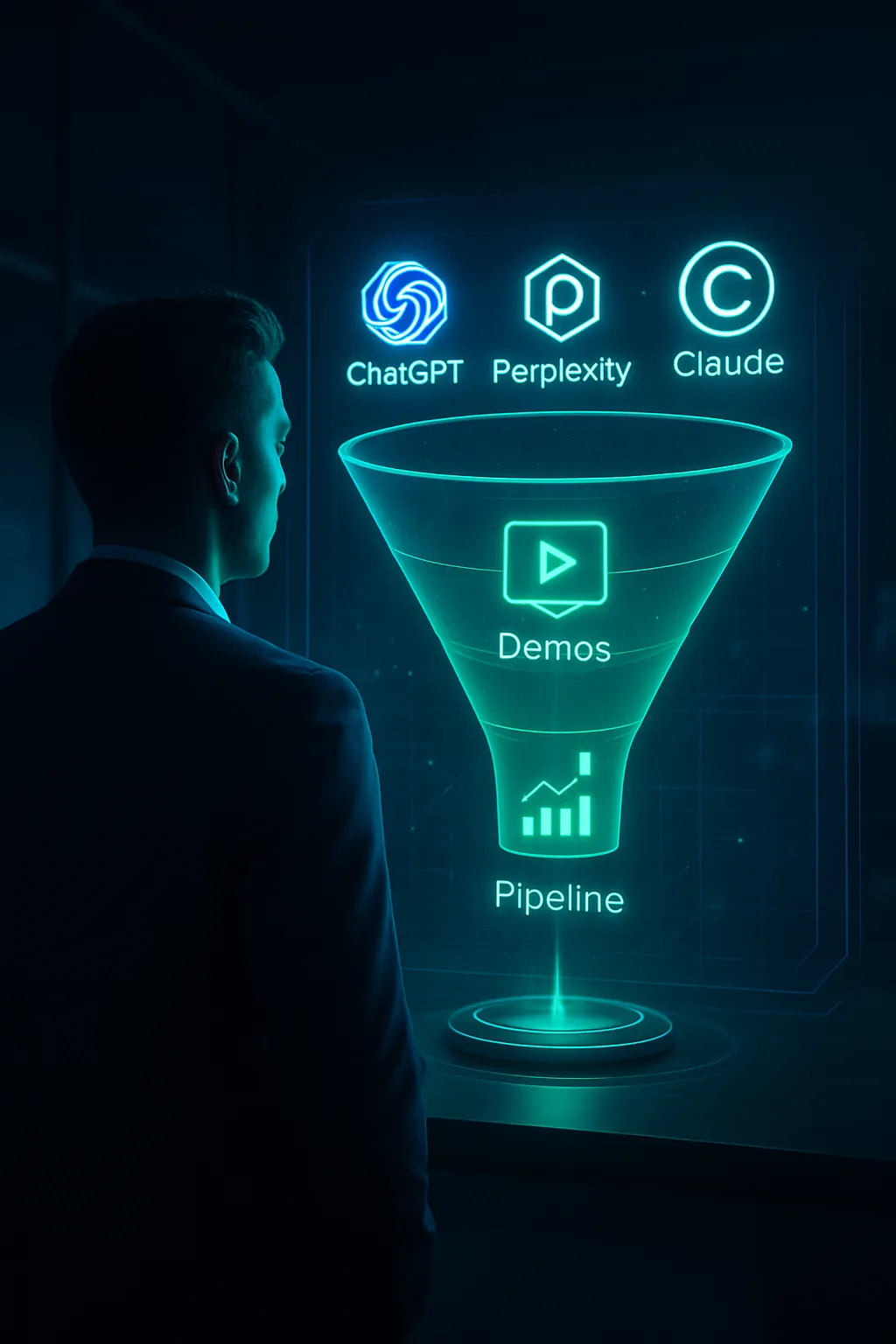
How Growth Marketers Turn AI Search Citations Into Qualified Pipeline
Learn how to connect AI visibility gains in ChatGPT and Perplexity to demos, trials, and pipeline using a practical, ROI-driven measurement framework for 2026.
How Growth Marketers Turn AI Search Citations Into Qualified Pipeline
In 2026, "visibility" is no longer enough. For growth marketers and demand generation leads, the novelty of seeing a brand name appear in a ChatGPT response or a Perplexity citation has worn off. The question from the C-suite is now singular and urgent: How does this convert into a demo, a trial, or a line item in the pipeline?
Connecting AI visibility to revenue requires moving beyond vanity metrics and treated Answer Engine Optimization (AEO) as a performance channel. Unlike traditional SEO, where a click-through rate (CTR) is the primary bridge to a conversion, AI search often functions as a "zero-click" environment or a "high-intent referral" engine. To capture value, you must change how you measure the journey from a Large Language Model (LLM) answer to a closed-won deal.
How can marketers connect AI visibility gains to demos, trials, and pipeline?
Marketers connect AI visibility to pipeline by mapping specific "intent-heavy" queries to conversion events, using correlated attribution to measure brand search lift, and deploying optimized landing pages designed specifically for users clicking through from AI citations. By treating AI platforms as mid-funnel discovery tools rather than just top-of-funnel awareness engines, teams can attribute trials and demos to the specific citations that influenced the prospect's decision-making process.
This connection is established through three primary mechanisms: correlated brand search volume (users seeing your name in an AI answer and then searching for you directly), referral traffic from LLM citations, and "self-reported attribution" in lead forms where prospects cite AI tools as their discovery source.
Why AI Visibility is the New Mid-Funnel Battleground
In the traditional funnel, a user might search for "best CRM for startups" and click on a listicle. In 2026, that same user asks Claude or Gemini to "Compare the top 3 CRMs for startups based on ease of use and API flexibility."
When the AI recommends your brand, it isn't just providing a link; it is providing a pre-vetted endorsement. This shifts the user's mindset from "researching" to "considering." If you are not visible in that specific recommendation, you are excluded from the shortlist before the user even reaches a search engine. Therefore, tracking your presence in these answers is the modern equivalent of tracking your position on a high-intent keyword, but with a significantly higher conversion potential due to the AI's perceived objectivity.
To see how your brand currently stacks up against competitors in these conversational environments, you can use an AI visibility explorer to identify where you are winning and where you are being left out of the conversation.
The 5-Step Playbook for Connecting AI Citations to Pipeline
This playbook provides a structured approach for growth teams to bridge the gap between being "mentioned" and getting "paid."
Step 1: Define and Track "Money Queries"
Not all AI visibility is created equal. A mention in a general query like "What is marketing automation?" is far less valuable than a mention in a query like "Which marketing automation tool has the best integration with Salesforce for a mid-market team?"
- Why it matters: You must prioritize queries that indicate a high intent to purchase. These are your "Money Queries."
- Action: Create a list of 50–100 specific prompts that a qualified buyer would ask when they are ready to buy. Track your brand’s share of voice (SOV) for these specific prompts across ChatGPT, Claude, and Perplexity. If you are mentioned in 80% of these, your pipeline should reflect that growth.
Step 2: Implement Correlated Attribution Models
Most LLMs strip UTM parameters from links, and many users will read an AI answer and then navigate to your site via a direct URL or a branded search on Google. This makes direct attribution difficult.
- Why it matters: Standard analytics will often miscategorize AI-driven traffic as "Direct" or "Organic Search."
- Action: Monitor the correlation between "AI Citation Spikes" and "Branded Search Volume." When your brand begins appearing more frequently in AI Overviews, you will typically see a 10–15% lift in people searching for your brand name directly. Use this correlation to assign a pipeline value to your AI visibility efforts. For more on this, see our guide on 8 essential AI visibility metrics for Gemini and Claude in 2026.
Step 3: Create "Citation-First" Landing Pages
When a user does click a citation in Perplexity or a link in a Google AI Overview, they are looking for specific evidence that supports the AI’s claim. If the AI said you have the "best API documentation," the link should lead to a page that immediately proves that claim.
- Why it matters: Generic homepages kill the momentum of an AI-referred lead.
- Action: Ensure your most cited pages are optimized for conversion. Use "Case Study Syntax" to make your evidence easily digestible for both the AI and the human reader. This increases the likelihood that a click turns into a trial sign-up. You can learn more about this in our breakdown of 5 steps to shift Claude’s recommendation bias using case study syntax.
Step 4: Add "How did you hear about us?" to CRM Forms
In a world of "Dark Social" and "Dark AI," the most reliable way to track pipeline impact is to ask the customer.
- Why it matters: It captures the influence of AI tools that don't pass referral data.
- Action: Add a mandatory (but simple) field to your demo request or trial sign-up form. Include "AI Assistant (ChatGPT, Claude, etc.)" as an option. This provides a hard data point in your CRM that connects a specific lead to an AI discovery event.
Step 5: Leverage Competitive Gap Analysis
If your competitors are being cited for features you also possess, you are losing pipeline to a "visibility gap."
- Why it matters: AI models are biased toward the most "consistent" and "cited" information. If your competitor has more third-party mentions, the AI will recommend them more often.
- Action: Identify the specific sources the AI is citing for your competitors. By securing mentions on those same sources (or creating better, more citable content), you can displace the competitor in the AI's recommendation engine, directly capturing their share of the pipeline. To understand how to benchmark this, review 7 essential AI visibility metrics for Gemini and how to track them.
A Worked Example: How "SaaS-X" Connected AI Visibility to $100k in Pipeline
Consider a hypothetical B2B SaaS company, SaaS-X, which provides project management software for architectural firms.
The Problem: SaaS-X was seeing steady traffic but stagnant demo requests. They noticed that when they asked Perplexity, "What is the best project management tool for architects?", their competitor was always listed first because the competitor had a widely cited whitepaper on "Architectural Workflow Automation."
The Strategy:
- Content Pivot: SaaS-X published a series of deeply technical guides on "BIM Integration for Project Management"—a niche but high-value topic for their persona.
- Monitoring: They tracked their visibility for the prompt "Compare project management tools with BIM integration."
- Result: Within six weeks, ChatGPT and Perplexity began citing SaaS-X as the "Technical Leader" for BIM-specific workflows.
- The Connection: SaaS-X saw a 22% increase in direct traffic to their "BIM Integration" feature page. By adding a "How did you hear about us?" field, they confirmed that 14 new high-value demo requests in one month specifically mentioned "finding the brand through ChatGPT."
The Outcome: By connecting the specific AI-cited feature (BIM Integration) to the demo requests, the growth team proved that their AEO efforts contributed to $100,000 in new qualified pipeline in a single quarter.
Decision Framework: Prioritizing AI Visibility Metrics
When deciding where to spend your growth budget, use this framework to evaluate which AI visibility gains will actually drive pipeline.
| Metric Type | High Pipeline Impact | Low Pipeline Impact |
|---|---|---|
| Query Intent | Comparative (Brand A vs Brand B) | Definitional (What is X?) |
| Citation Depth | Direct link to product/pricing | Mention in a generic list of 20 |
| Sentiment | "Recommended for technical teams" | "Also mentioned in this space" |
| User Context | Professional/B2B prompts | Student/Educational prompts |
Limitations and Considerations
While connecting AI visibility to pipeline is essential, marketers must be aware of the "Attribution Lag." AI models do not update their training data or their RAG (Retrieval-Augmented Generation) indexes in real-time. A change you make to your website today may take days or even weeks to reflect in an AI's answer.
Furthermore, "hallucinations" can occur where an AI cites your brand for a feature you don't have. While this might drive a trial, it will lead to a poor conversion rate from trial-to-paid. Accuracy in AI visibility is just as important as the volume of visibility.
What is the most important next action to take this week?
The single most effective action a growth marketer can take this week is to audit your lead intake form.
Before you spend another dollar on content or optimization, ensure you have a way to capture "AI Discovery" as a lead source. By adding "AI Search/Assistant" to your attribution dropdown or open-text field, you begin building the historical data needed to prove ROI. Once that is in place, use an AI visibility explorer to identify the top three "Money Queries" where your brand is currently missing and create one piece of high-authority content to address that gap.
Connecting AI visibility to pipeline is not a one-time setup; it is a continuous loop of monitoring, optimizing, and measuring the lift in your core business outcomes.
Stay visible as AI search evolves
Practical research on AI visibility, citations, crawler activity, shopping recommendations, and GEO strategy.
Useful insights only. Unsubscribe anytime.