
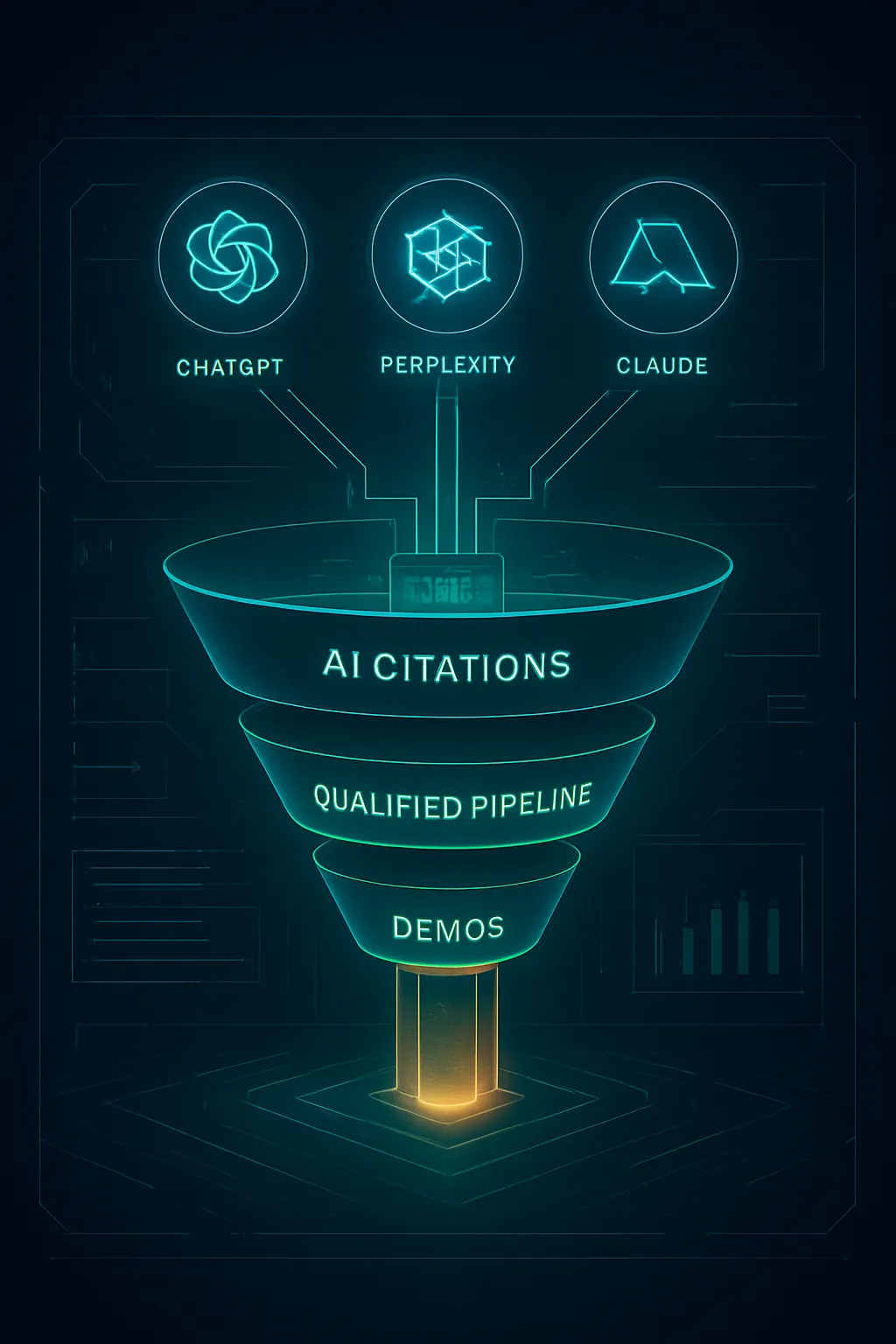
AI Citations vs. Qualified Pipeline: Which Metric Proves AI ROI in 2026?
Learn how to connect AI visibility in ChatGPT and Perplexity to demos and revenue. A practical playbook for growth marketers to measure and scale AEO impact.
AI Citations vs. Qualified Pipeline: Which Metric Proves AI ROI in 2026?
For B2B growth marketers and lean startup teams, the rise of answer engines like ChatGPT, Claude, and Perplexity has created a massive attribution blind spot. While traditional SEO provided a clear path from keyword to click to conversion, AI search often results in "zero-click" discovery where the user gets their answer—and your brand recommendation—without ever visiting your website. This creates a high-stakes challenge: how do you prove that appearing in an AI-generated answer actually drives demos, trials, and pipeline?
To connect AI visibility to revenue, marketers must shift from tracking raw mentions to measuring "Citation Intent Alignment" and correlating AI Share of Voice (SOV) with branded search lift and self-reported attribution. By identifying which specific AI queries lead to high-intent actions, you can move beyond vanity metrics and treat AI search as a performance-driven acquisition channel.
How can marketers connect AI visibility gains to demos, trials, and pipeline?
Marketers connect AI visibility to pipeline by triangulating three data points: AI citation share for high-intent queries, branded search volume increases, and self-reported attribution in lead forms. Because LLMs often act as a "pre-filtering" layer for buyers, a brand that is consistently recommended in AI answers will see a measurable lift in direct traffic and "How did you hear about us?" mentions of specific AI platforms. Success is measured by the conversion rate of traffic that arrives after an AI interaction, which current data suggests is up to 31% higher than standard organic search.
This playbook outlines the exact steps for B2B marketers to bridge the gap between being "cited" and being "bought."
Step 1: Audit Your Citation-to-Intent Alignment
Not all AI visibility is created equal. Being cited in a broad query like "What is cloud security?" is a top-of-funnel awareness play, but it rarely drives an immediate demo. To build a pipeline, you must prioritize visibility for "commercial intent" queries—the questions buyers ask when they are ready to shortlist a solution.
Start by categorizing your AI visibility into three buckets: informational, comparative, and transactional. Use an AI visibility explorer to see which queries currently trigger your brand as a recommended source. If you are appearing for educational definitions but missing from "Best [Category] software for [Use Case]" comparisons, your visibility is disconnected from your pipeline.
Focus your optimization efforts on "Problem-Solution" clusters. For example, instead of just aiming for a mention, ensure the LLM cites your specific ROI metrics or unique features. This ensures that when a user reads the AI's answer, the "logical next step" is to visit your site for a trial or demo. For more on this, see Growth Marketers: Scale One Pain Point into an AI-Search Cluster for Trials.
Step 2: Implement Self-Reported Attribution (SRA)
Since many AI platforms do not pass traditional UTM parameters or referrer data, the most reliable way to connect a demo request to an AI citation is to ask the user. In 2026, "Dark Social" has evolved into "Dark AI," where research happens in private chat interfaces that Google Analytics cannot see.
Add a mandatory, open-ended field to your demo and trial sign-up forms: "How did you first hear about us?" Growth teams are finding that users are increasingly specific, writing responses like "ChatGPT recommended you for SOC2 compliance" or "Found you in a Perplexity comparison of CRM tools."
By tagging these leads in your CRM as "Source: AI Search," you can begin to calculate a Cost Per Acquisition (CPA) for your Answer Engine Optimization (AEO) efforts. This qualitative data is the "smoking gun" needed to justify further investment in AI search visibility. If you're struggling with this, review Why AI Citations Fail to Convert and How to Track Them to Demos for deeper attribution strategies.
Step 3: Correlate AI Share of Voice with Branded Search Lift
There is a direct correlation between how often a brand is cited in LLMs and the volume of people searching for that brand by name on Google. When an AI assistant mentions your company as a top solution, the user’s next action is often to search for "[Your Brand] reviews" or "[Your Brand] pricing."
To measure this, track your "Citation Share" (the percentage of time you are cited in a specific query set) against your branded search trends. If your Citation Share in Claude and Gemini increases by 20% over a quarter, and your branded search volume grows by 15% in the same period, you have a statistically significant correlation. This "triangulation" method allows you to claim credit for the pipeline growth even without a direct click-through from the AI interface itself.
Step 4: Map the "AI Brand Mention Valuation" (ABMV)
In the 2026 marketing landscape, growth teams are adopting the AI Brand Mention Valuation model. This framework treats every AI citation as a premium contextual placement. Unlike a standard search result, an AI citation often comes with a conversational endorsement.
To calculate your ABMV, assign a dollar value to citations based on the query's difficulty and intent level. A mention in a high-intent query (e.g., "Which payroll software is best for startups?") is valued higher than a mention in a general query. When you present your quarterly results, show the growth in "High-Value Mentions" alongside your demo count. This demonstrates that you aren't just getting "found"—you are being positioned as the authority in the most critical moments of the buyer journey.
Step 5: Optimize for "Recommendation Bias"
To turn visibility into pipeline, you need the AI to do more than just list your name; you need it to recommend you. This requires moving from passive content to "Structured Proof Points." LLMs are trained to look for consensus and evidence. If your website contains clear, data-backed case studies and comparison tables, the AI is more likely to use that data to justify why it is recommending you over a competitor.
Marketers should ensure that their most important conversion-driving data (like "30% faster implementation" or "50% cheaper than Competitor X") is presented in a way that is easily ingestible by AI crawlers. This is often the difference between a neutral mention and a high-converting recommendation that leads directly to a trial sign-up. For a deeper dive into the strategic side of this, read 4 Strategic Steps to Link AI Search Visibility to Pipeline and Revenue.
A Worked Example: How a Fintech Startup Scaled Pipeline via Perplexity
Consider a mid-sized B2B Fintech company, "LedgerLens," that specializes in automated tax compliance for e-commerce. In early 2026, they noticed they were being cited in ChatGPT for general tax questions but were absent from Perplexity’s "Best tax tools for Shopify" answers.
The Problem: High visibility for low-intent queries, zero visibility for high-intent queries, leading to zero traceable pipeline from AI.
The Strategy:
- Content Pivot: They created a series of highly specific comparison pages and "How-to" guides specifically targeting Shopify-related tax pain points.
- AEO Optimization: They used clear, declarative headers like "Why LedgerLens is the top-rated Shopify tax tool for 2026" to make their value proposition easy for LLMs to extract.
- Measurement: They added "AI Search" as a dropdown option in their "How did you hear about us?" form and began tracking branded search lift for the term "LedgerLens Shopify tax."
The Result: Within three months, their Citation Share for Shopify-related queries rose from 5% to 42%. Simultaneously, their demo requests from e-commerce founders increased by 28%, with 12% of those leads explicitly naming Perplexity or ChatGPT as their discovery source. By connecting the visibility gain to the specific segment (Shopify founders), they proved that AEO was their most efficient lead-gen channel.
Visibility vs. Conversion: Which Metrics Actually Matter?
When reporting to leadership, it is crucial to distinguish between "Vanity Visibility" and "Pipeline Visibility." Use the following table to prioritize your focus:
| Metric Type | Example | Pipeline Impact | Action |
|---|---|---|---|
| Vanity Visibility | Total mentions for "What is..." queries | Low | Monitor, but don't over-invest. |
| Authority Visibility | Citations in industry whitepapers/reports | Medium | Use for brand positioning. |
| Pipeline Visibility | Recommendations in "Best of" or "Top [Category]" | High | Prioritize AEO optimization here. |
| Conversion Visibility | Citations that include your pricing or specific ROI | Very High | Ensure this data is accurate and fresh. |
Prioritized Next Action: Audit Your High-Intent Queries
If you only do one thing this week, identify the top 10 questions your customers ask during the sales process (e.g., "How does [Your Brand] compare to [Competitor]?" or "What is the implementation time for [Your Brand]?"). Manually run these queries through ChatGPT, Claude, and Perplexity.
If your brand isn't appearing—or if the information provided is outdated—you have a pipeline leak. Fixing these high-intent gaps is the fastest way to turn AI visibility into measurable revenue. For more tactical advice on comparing your traditional SEO performance with these new AI metrics, check out How Do I Compare Website SEO and AI Visibility in 2026?. Understanding the delta between where you rank in Google and where you are cited in AI is the first step toward a unified growth strategy.
Stay visible as AI search evolves
Practical research on AI visibility, citations, crawler activity, shopping recommendations, and GEO strategy.
Useful insights only. Unsubscribe anytime.