
Short answer
An AI harness turns a model into a working agent
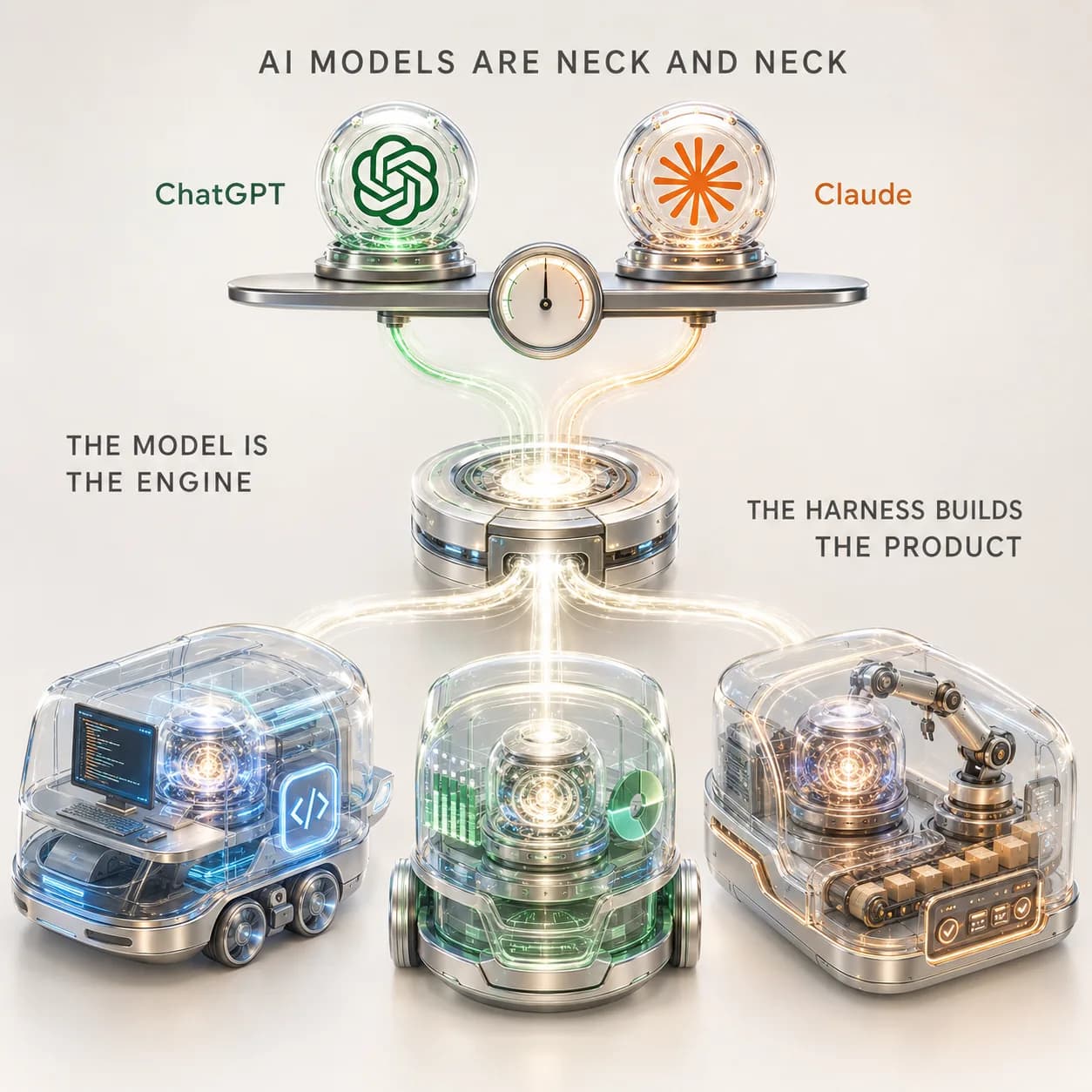
A language model can generate text, reason over the context it sees, and propose what might happen next. It cannot, by itself, inspect a live codebase, call an internal API, preserve durable project state, enforce a permission policy, or prove that a multi-step task is finished. The harness supplies those missing operating conditions.
This formula is a useful mental model, not a formal industry standard. In practice, different teams draw the boundary between a framework, harness, runtime, and agent differently. The important distinction is operational: the model reasons, while the harness controls how that reasoning becomes action.
The vocabulary
AI model vs agent vs harness vs framework
These terms are often used interchangeably, but separating them makes architecture decisions much easier. A team may swap the model without replacing its harness, or replace a framework while keeping the same runtime controls.
Model
Generates reasoning, predictions, and responses from the context it receives.
What can it infer?
Agent
Pursues a goal by deciding what to do next and using the available system.
What should happen next?
Harness
Runs the loop, supplies context and tools, enforces boundaries, and checks progress.
How can the work happen safely?
Framework
Provides libraries and abstractions developers can use to assemble agent systems.
What can developers build with?
Runtime
Provides the execution environment where the agent and its tools actually run.
Where does it execute?
Agent harness architecture
The eight parts of a modern AI harness
A harness does not need every component on day one. A simple single-turn assistant may only need a model call, a small tool registry, and an output check. Long-running agents need more structure because context, state, failure, and permissions compound over time.
Agent loop
The repeated cycle that calls the model, decides whether a tool is needed, executes the tool, and returns the result for another step.
Context assembly
The logic that selects instructions, conversation history, files, retrieved sources, tool results, and other context for the next model call.
Tools and skills
The registry of APIs, filesystem operations, browsers, MCP servers, scripts, and higher-level capabilities the agent is allowed to use.
State and memory
Short-lived task state and durable records that help work continue across turns, sessions, context windows, or specialized agents.
Permissions and sandboxing
Rules that limit what the agent can read, write, execute, publish, or change, with approval gates for higher-risk actions.
Verification and recovery
Tests, schemas, checks, retries, rollback paths, and explicit stopping conditions that prevent a plausible-looking result from being treated as done.
Observability
Traces, tool-call logs, timing, costs, errors, and artifacts that let people understand what happened without reading a private transcript line by line.
Human handoffs
Clear points where the harness pauses, asks for a decision, escalates a risk, or returns control instead of continuing blindly.
Runtime loop
How an AI harness works step by step
Receive a goal
The user provides an objective, constraints, and any relevant starting context.
Assemble context
The harness selects project knowledge, history, tools, permissions, and current state.
Ask the model
The model proposes a response or a structured next action within the assembled context.
Gate the action
The harness validates the tool call, checks permissions, and applies safety or policy rules.
Execute and observe
A tool runs, the result is recorded, and evidence is added back to the working context.
Verify or continue
Tests and success criteria decide whether to finish, retry, revise, escalate, or continue.
Why the term matters now
The model is only one part of agent performance
As teams move from one-shot answers to agents that work for minutes, hours, or multiple sessions, the surrounding system becomes visible. The agent must know which context is authoritative, which tools are available, which actions need approval, how to recover from an error, and what evidence proves that the task succeeded.
That is why current engineering discussions increasingly focus on harness engineering, context engineering, tool ergonomics, session persistence, and verification. The model still matters for reasoning quality, speed, cost, and modality. The harness determines whether that capability can be applied consistently inside a real environment.
Weak harness
A broad prompt, ambiguous tools, no durable state, unbounded retries, and a green-looking final answer with no evidence.
Strong harness
Clear task boundaries, selected context, scoped tools, visible state, permission gates, feedback, and a verifiable stopping condition.
Related disciplines
Harness engineering vs prompt engineering vs context engineering
Prompt engineering improves the instructions sent to a model. Context engineering improves the selection and organization of the information the model sees. Harness engineering includes both, but adds the runtime that executes actions, persists state, enforces permissions, and verifies outcomes.
Prompt engineering
Instruction quality
Role, objective, constraints, examples, output format, and evaluation criteria.
Context engineering
Information quality
What the model sees now: files, history, retrieved evidence, state, and tool results.
Harness engineering
System behavior
How the whole agent loop acts, recovers, persists, observes, and stays within policy.
Concrete example
What an AI coding harness changes
Imagine asking an agent to fix a failing test. A raw model can suggest a patch from a pasted error message. A coding harness can inspect the repository, find the relevant files, run the test, observe the actual failure, edit the code, rerun the test, run related checks, and leave a trace of what changed.
Goal: fix the failing checkout test

Harness context:
- repository map and architecture rules
- current branch and changed files
- test command and environment health
- relevant task history and previous failures

Allowed actions:
- read repository files
- edit source and test files
- run scoped tests and linters
- request approval before publishing

Completion gate:
- targeted test passes
- related checks pass
- diff is reviewed for scope
- result and remaining risks are recorded
The model still decides how to reason about the bug. The harness makes the task observable, bounded, repeatable, and connected to evidence. That is the practical difference between a promising answer and a system that can safely do work.
Implementation checklist
How to build a reliable AI harness
Start with the smallest loop that can complete one real task, then add the controls that address observed failure modes.
Brand and AI search
Why AI harnesses matter for AI search visibility
The same architecture matters when an AI system researches brands, products, or categories. A useful AI-search workflow needs current sources, controlled retrieval, citation evidence, clear claim boundaries, and a way to compare answers over repeated prompts. Without those controls, a system can produce a fluent recommendation without making its source path or uncertainty visible.
Retrieve
Gather the pages, facts, and sources relevant to a commercial question.
Verify
Check claims, source quality, freshness, and whether the answer actually supports the recommendation.
Learn
Persist prompt results, citation patterns, and content gaps so the next run improves.
Continue learning
Prompt engineering is one layer of the harness
Use these guides to improve the instructions, context, and QA loops that feed a larger agent system.
How to Write Better Prompts
Specify objectives, context, constraints, output shape, and success criteria before the harness runs the task.
Read the guide →
Prompt Engineering for SEO Content Teams
Use structured briefs, entity coverage, content gaps, and QA passes as inputs to a repeatable content harness.
Read the guide →
Prompt Debugging Checklist
Diagnose whether a weak result comes from the instruction, context, tool interface, output contract, or verification layer.
Read the guide →
Claude Prompt Engineering Best Practices
Improve long-context workflows with clearer sections, explicit assumptions, and a deliberate validation pass.
Read the guide →
FAQ
Common questions about AI harnesses
What is an AI harness?
An AI harness is the software layer around a model that provides the agent loop, context, tools, state, permissions, execution environment, verification, and recovery. The model supplies reasoning; the harness makes that reasoning usable for multi-step work.
What is the difference between an AI agent and an AI harness?
An agent is the goal-directed system performing the work. The harness is the surrounding runtime and control system that lets the agent act: it selects context, exposes tools, stores state, checks permissions, records evidence, and decides when the work should continue or stop.
Is an AI harness the same as an agent framework?
No. A framework is a set of developer libraries and abstractions used to assemble agent systems. A harness is the configured, operating system around a model that actually runs the loop, manages tools and state, enforces controls, and handles execution in a real workflow.
What is harness engineering?
Harness engineering is the practice of designing and improving the system around an AI model: its context, tools, workflow, permissions, state, feedback loops, evaluations, and recovery paths. It is broader than prompt engineering because it changes the execution environment, not only the instruction text.
Why do long-running AI agents need a harness?
Long-running work crosses context windows, encounters failures, changes files or systems, and needs durable progress. A harness gives each session a reliable starting state, preserves artifacts and decisions, controls actions, and verifies progress instead of relying on the model to remember everything.
Does a better model make the harness unnecessary?
No. A stronger model can improve reasoning, but it still needs tools, current context, permissions, state, and feedback to complete real work safely. The right balance depends on the task, but production reliability is a property of the model, harness, and environment together.
Further reading
Research and engineering references
- OpenAI: Harness engineering in an agent-first world ↗
- Anthropic: Effective harnesses for long-running agents ↗
- LangChain: The anatomy of an agent harness ↗
- Martin Fowler: Harness engineering for coding agent users ↗
- Arize: What is an agent harness? ↗
- Research: AI Harness Engineering as a runtime substrate ↗