
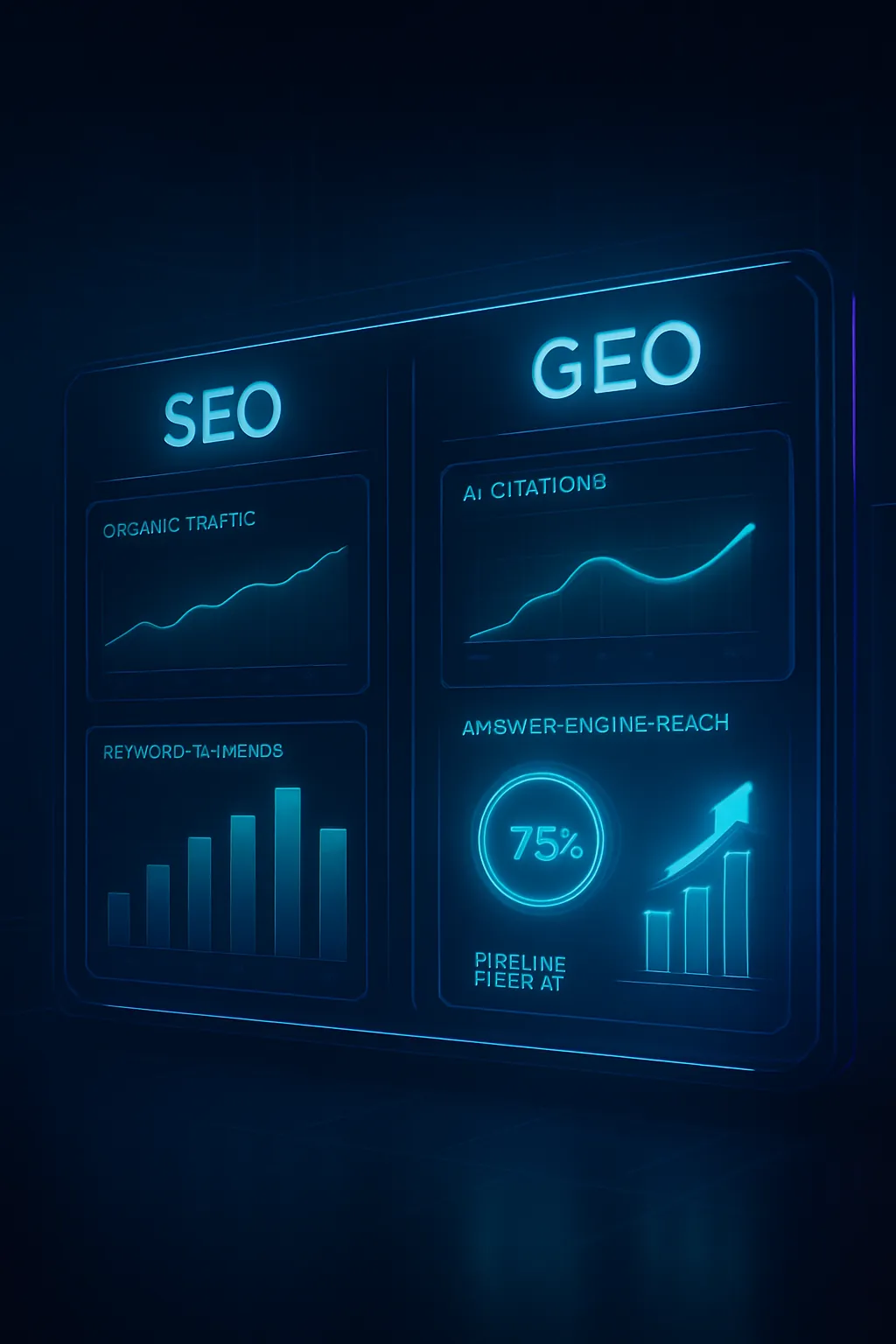
SEO vs. GEO: Which Drives More Pipeline in 2026?
Discover the key differences between SEO and GEO for B2B marketers. Learn which strategy—traditional SEO or Generative Engine Optimization—will drive more pipeline impact in 2026.
SEO vs. GEO: Which Drives More Pipeline in 2026?
For B2B growth marketers, the ultimate goal is pipeline. But in 2026, the channels and tactics for generating that pipeline are rapidly evolving. Traditional Search Engine Optimization (SEO) has long been the bedrock of digital demand generation, driving organic traffic and leads. However, the rise of Generative AI, answer engines like ChatGPT, Claude, and Perplexity, and AI Overviews from Google presents a new frontier: Generative Engine Optimization (GEO).
This post dives into the core differences between SEO and GEO, focusing on which strategy—or combination thereof—will deliver the most impactful pipeline growth for B2B marketers in the coming year. We'll break down how to approach each, what metrics matter most, and how to allocate your resources for maximum ROI.
What is Generative Engine Optimization (GEO)?
Generative Engine Optimization (GEO) is the strategic practice of optimizing digital content and brand presence to be discoverable, understandable, and citable by Generative AI models and answer engines. It focuses on ensuring that AI assistants—whether for direct answers, content summarization, or code generation—surface your brand's expertise and information accurately and favorably. GEO aims to secure brand mentions, citations, and direct answers within AI-generated responses, thereby driving qualified traffic and leads.
GEO is about ensuring your brand's knowledge is the authoritative source that AI models learn from and reference when responding to user queries.
What is Traditional Search Engine Optimization (SEO)?
Traditional Search Engine Optimization (SEO) is the process of improving a website's visibility in search engine results pages (SERPs) for relevant keywords. The primary goal is to increase organic (non-paid) traffic to a website by ranking higher in search engine results, typically for informational, navigational, or transactional queries. SEO involves technical optimization, on-page content refinement, and off-page authority building (like backlinks).
SEO is about optimizing your website to rank highly in traditional search engine listings for specific keyword queries.
SEO vs. GEO: A Marketer's Pipeline Impact Comparison
| Feature / Strategy | Traditional SEO | Generative Engine Optimization (GEO) |
|---|---|---|
| Primary Goal | Rank high in SERPs for target keywords. | Get cited/featured in AI answers & LLM outputs. |
| Target Audience | Users actively searching via text queries. | AI models and users interacting with AI assistants. |
| Key Metrics | Organic traffic, keyword rankings, conversion rates. | AI citation rate, brand mention volume, AI-driven traffic, lead quality from AI. |
| Content Focus | Keyword density, relevance, user intent, E-E-A-T. | Factual accuracy, clarity, structured data, quotable snippets, authority. |
| Distribution Channel | Google, Bing, DuckDuckGo (SERPs). | ChatGPT, Claude, Perplexity, Google AI Overviews, Gemini, Copilot. |
| Pipeline Impact | Historically strong, direct lead generation. | Emerging, high-potential for niche authority & early-funnel engagement. |
| Technical Depth | Crawler optimization, site speed, schema. | Prompt engineering understanding, data formatting, knowledge graph alignment. |
Why GEO is Crucial for B2B Pipeline in 2026
As AI assistants become the primary interface for information discovery, relying solely on traditional SEO is becoming insufficient. Here's why GEO offers a distinct advantage for pipeline generation:
- Early Funnel Dominance: AI answers often capture users at the very top of the funnel, before they even formulate a specific search query. If your brand is cited here, you establish authority and capture attention when intent is nascent.
- Niche Authority: GEO allows you to become the definitive source for specific, complex queries within your B2B niche. This positions you as an indispensable expert, driving highly qualified leads.
- Reduced Competition for Direct Answers: While traditional SEO is a crowded space, the optimization strategies for AI answers are still emerging. Gaining visibility now can create a significant competitive moat.
- Enhanced Brand Trust: Being cited by trusted AI models lends credibility. Users are more likely to trust information that an AI assistant has validated and presented as authoritative.
Quotable Takeaway: "In 2026, GEO isn't just an add-on to SEO; it's a critical pathway to capturing early-funnel B2B demand that traditional search may miss as AI assistants become the default information interface."
The Answer Engine Optimization (AEO) Playbook for Pipeline Impact
Answer Engine Optimization (AEO) is a term often used interchangeably with GEO, focusing on optimizing content for AI assistants. Here’s a playbook designed to drive pipeline by ensuring your brand is seen, heard, and cited.
Step 1: Identify High-Intent AI Query Clusters
Instead of just keyword research, map out the questions your target audience is likely asking AI assistants. Think about the problems they're trying to solve, the comparisons they're making, and the definitions they need.
Action: Brainstorm 20-30 question-based queries related to your core products/services. Use tools or analyze common questions in forums and communities.
Example AI Query Clusters for a B2B SaaS CRM:
- "What are the best CRM features for small business sales teams?"
- "How to choose a CRM for managing complex B2B sales pipelines?"
- "Compare Salesforce vs. HubSpot for enterprise B2B sales."
- "Define sales enablement software."
Step 2: Create Direct-Answer Content Assets
Build content specifically designed to be extracted and cited by AI models. Each piece should provide immediate value without forcing users to click through.
High-impact content formats:
Definitive guides: "The Complete Guide to Revenue Operations for Scaling B2B Companies" Comparison frameworks: "Choosing Between Product-Led Growth vs. Sales-Led Growth: A Decision Matrix" Implementation playbooks: "90-Day Account-Based Marketing Implementation Timeline for Mid-Market SaaS" ROI calculators: "How to Calculate Customer Lifetime Value for Subscription Businesses" Glossary entries: Clear definitions of industry terms like "lead scoring," "intent data," or "multi-touch attribution"
Each piece should start with a quotable, definitive answer, then expand with frameworks, data, and examples.
Step 3: Optimize for AI Model Training Preferences
AI models favor certain content characteristics. Structure your content accordingly:
Specificity over generality: "How to reduce churn in B2B SaaS companies with annual contracts" beats "customer retention strategies"
Data-backed claims: Include percentages, benchmarks, and timeframes. "Companies using predictive lead scoring see 25-35% higher conversion rates within 6 months"
Clear cause-effect relationships: "When sales and marketing teams align on ICP definitions, deal velocity increases by 40%"
Actionable frameworks: Provide step-by-step processes that AI can reference when users ask "how to" questions
Comparative analysis: Fair, balanced comparisons that help buyers make informed decisions
Step 4: Build Cross-Platform Authority
GEO success requires visibility beyond your own website. AI models synthesize information from multiple sources, so your authority needs to be evident across platforms.
Distribution tactics:
LinkedIn thought leadership: Publish insights on emerging trends like "Why Pipeline Generation Requires Rethinking Attribution Models in 2026"
Industry publication bylines: Contribute to TechCrunch, Forbes, or vertical-specific outlets on topics like "The Death of MQLs: What B2B Teams Should Measure Instead"
Podcast appearances: Discuss your expertise on shows covering sales technology, growth strategies, or marketing operations
Webinar content: Host educational sessions on "Building a Demand Generation Engine Without Paid Ads" and repurpose transcripts
Community contributions: Answer questions on Reddit's r/sales, r/marketing, or industry-specific Slack communities
Each appearance reinforces your authority across the data sources AI models reference.
Measuring Pipeline Impact: SEO vs. GEO
Track distinct metrics for each strategy to understand true pipeline contribution.
Traditional SEO Pipeline Metrics:
- Organic traffic to key landing pages
- Keyword rankings for commercial intent terms
- Form submissions from organic search
- SQLs with organic search as first touch
- Revenue attributed to organic channel
GEO Pipeline Metrics:
- Brand mention frequency in AI responses for target queries
- Citation rate with source links to your content
- Traffic from AI platform referrals (when trackable)
- Demo requests mentioning AI research in qualification
- Deal influence where buyers cite AI-discovered content
Combined Attribution:
- Multi-touch analysis showing both SEO and AI touchpoints
- Content asset performance across both channels
- Time-to-close for deals with vs. without AI citations
- Customer acquisition cost comparison by channel
Resource Allocation: How to Balance SEO and GEO Investment
Most B2B teams should adopt a portfolio approach, not an either/or decision.
Recommended allocation for different scenarios:
Early-stage startups (limited resources):
- 70% GEO, 30% SEO
- Focus on becoming the definitive source for niche questions
- Build authority in emerging AI channels before competition intensifies
Growth-stage companies (scaling revenue):
- 50% SEO, 50% GEO
- Maintain existing organic traffic while capturing AI-driven demand
- Test and learn across both channels to identify highest ROI
Enterprise organizations (established presence):
- 60% SEO, 40% GEO
- Protect existing organic rankings and traffic
- Strategically expand into GEO for competitive differentiation
High-competition verticals (crowded markets):
- 55% GEO, 45% SEO
- Differentiate through AI citations where traditional rankings are saturated
- Target long-tail, specific questions where AI answers dominate
Industry-Specific GEO Strategies
Different B2B sectors require tailored approaches to maximize GEO pipeline impact.
Enterprise Software & SaaS: Focus on implementation guides, integration documentation, and ROI frameworks. Target questions like "How to migrate from [legacy system] to [modern platform]" or "What's the typical implementation timeline for enterprise resource planning software?"
Financial Services & FinTech: Prioritize regulatory compliance content, risk assessment frameworks, and financial calculation methodologies. Own answers to "What are SOC 2 compliance requirements for payment processors" or "How to calculate weighted average cost of capital for SaaS valuations."
Healthcare Technology: Dominate clinical workflow optimization, interoperability standards, and patient data security. Become the source for "HIPAA compliance checklist for telehealth platforms" or "How to achieve HL7 FHIR integration."
Professional Services: Create definitive methodologies, maturity models, and assessment frameworks. Target "How to conduct a cybersecurity risk assessment for healthcare organizations" or "Best practices for M&A due diligence in SaaS acquisitions."
The Hybrid Content Strategy
The most effective approach combines SEO and GEO principles in every piece of content.
Example: Creating a hybrid guide on "Sales Forecasting Accuracy"
SEO optimization:
- Target keyword: "improve sales forecasting accuracy"
- Optimize title, headers, and meta description
- Include related terms: pipeline visibility, revenue predictability, forecast variance
- Build backlinks from sales enablement blogs
GEO optimization:
- Lead with direct answer: "Sales forecasting accuracy improves by 30-50% when teams combine historical data analysis, AI-powered predictive models, and weekly pipeline reviews"
- Structure with clear Q&A sections AI can extract
- Include specific formulas: "Forecast Accuracy = (Actual Revenue / Forecasted Revenue) × 100"
- Provide decision framework: "When to use bottom-up vs. top-down forecasting"
This dual optimization maximizes visibility across both traditional search and AI answers.
Common GEO Mistakes That Kill Pipeline
Mistake 1: Treating GEO like keyword stuffing Don't force "AI-friendly" language that sounds unnatural. Focus on clarity and directness.
Mistake 2: Ignoring competitive citations If AI consistently cites competitors for your core topics, you're losing mindshare. Audit and address gaps.
Mistake 3: No measurement framework Without tracking AI citations and their pipeline impact, you can't prove ROI or optimize strategy.
Mistake 4: Siloed teams GEO requires collaboration between content, SEO, product marketing, and sales enablement. Break down silos.
Mistake 5: Only optimizing for ChatGPT Diversify across Claude, Perplexity, Google AI Overviews, and emerging platforms.
The 2026 Prediction: GEO's Growing Pipeline Share
Based on current adoption trends and platform evolution, GEO will likely drive 20-30% of total pipeline for early adopters by end of 2026, with this percentage growing to 40-50% by 2027 for B2B companies in knowledge-intensive sectors.
Traditional SEO won't disappear, but its share of pipeline will compress as AI answers increasingly satisfy user intent without requiring clicks to websites.
The winning strategy: Invest aggressively in GEO now while competition is limited, while maintaining strong SEO fundamentals to protect existing traffic and conversions.
Action Plan: Your First 90 Days
Month 1: Foundation
- Audit top 20 customer questions and map to content gaps
- Test current AI citation rate for brand and category queries
- Identify 5 competitors dominating AI answers in your space
- Establish baseline metrics for both SEO and GEO
Month 2: Content Creation
- Publish 8-10 direct-answer content pieces optimized for GEO
- Update existing high-traffic pages with quotable answers
- Launch one definitive guide (3,000+ words) on core topic
- Begin cross-platform distribution campaign
Month 3: Optimization & Measurement
- Re-test AI platforms for citation improvements
- Analyze which content formats drive highest AI visibility
- Calculate preliminary pipeline influence from GEO efforts
- Refine strategy based on early results
Conclusion: The And, Not Or, Approach
The question isn't "SEO or GEO?" but "How do we excel at both while resources are finite?"
For most B2B marketers, the answer is strategic prioritization based on buyer behavior. If your ICP increasingly uses AI for research, discovery, and vendor evaluation, GEO becomes mission-critical. If traditional search still drives the majority of qualified traffic, SEO remains paramount.
The smartest play? Build content that wins in both channels. Start with direct answers AI can cite, then expand with depth that ranks in traditional search. Track performance across both. Double down on what drives pipeline.
The B2B brands that will dominate demand generation in 2027 are those mastering this hybrid approach today.
Stay visible as AI search evolves
Practical research on AI visibility, citations, crawler activity, shopping recommendations, and GEO strategy.
Useful insights only. Unsubscribe anytime.