
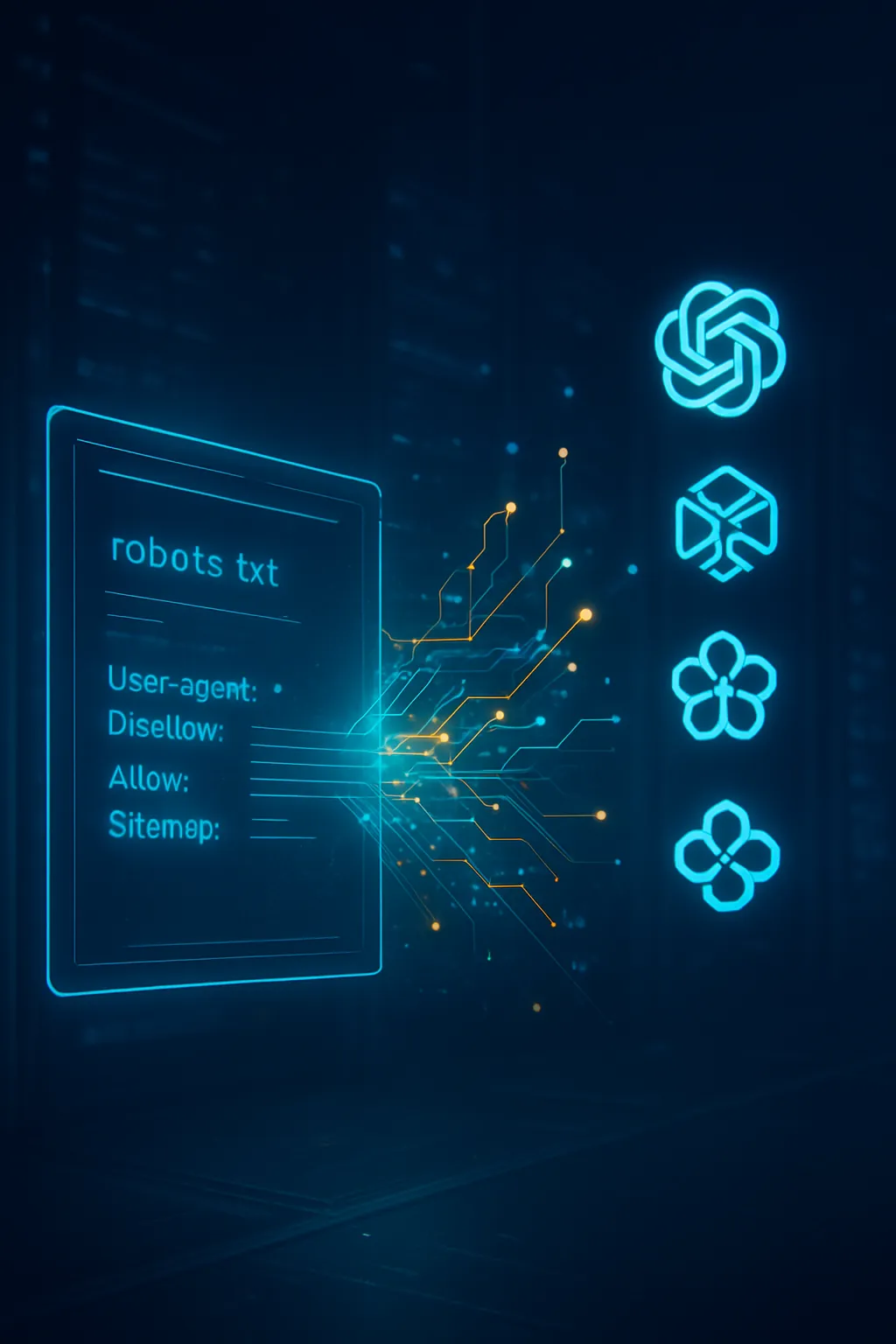
6 Ways to Move from Robots.txt Checkers to AI-Powered Crawlability
Learn how to evolve from basic robots.txt checkers to advanced AI-powered crawlability. Master AEO to secure high-value citations in ChatGPT and Perplexity.
From "Robots.txt Checker" to AI-Powered Crawlability: Optimizing for the New Search Landscape
In 2026, the goal of technical SEO has shifted from merely being indexed to being cited. Traditional "Robots.txt Checkers" are no longer sufficient because they only tell you what is blocked, not how an LLM interprets your content. To win in the age of Answer Engine Optimization (AEO), marketers must transition to AI-powered crawlability—a proactive strategy that ensures your brand’s most important data is accessible, structured, and authoritative for generative agents.
TL;DR
- AI-Powered Crawlability is the next evolution of technical SEO, focusing on how LLMs ingest and cite data rather than just how search bots index pages.
- Robots.txt is now a strategic tool, used to prioritize high-value training data for AI agents like OAI-SearchBot and PerplexityBot.
- Structured feeds and API-first content are replacing traditional sitemaps as the primary way to influence AI answers.
- Brand protection requires monitoring how AI agents crawl your site to prevent data scraping that leads to brand hallucinations.
What is AI-Powered Crawlability?
AI-Powered Crawlability is a technical framework designed to ensure that Large Language Models (LLMs) and generative search engines can easily access, parse, and attribute your website's content. Unlike traditional crawling, which focuses on link discovery and page indexing, AI-powered crawlability optimizes for "citation readiness" by providing clean, context-rich data that AI agents can use to generate direct answers for users.
FAQ 1: How does AI-powered crawlability differ from traditional SEO crawling?
The primary difference lies in the objective: traditional crawling seeks to index a page for a search engine results page (SERP), while AI crawlability seeks to feed a model for a generative answer. Traditional bots (like Googlebot) look for keywords and backlinks to rank a page. AI agents (like OAI-SearchBot) look for semantic relationships, factual density, and structured data that allow them to synthesize an answer and provide a citation.
In the old landscape, you used a "Robots.txt Checker" to ensure you weren't accidentally blocking your site. In the 2026 landscape, you use Brand Armor AI to ensure that when an AI agent crawls your site, it finds the "Source of Truth" for your brand. This requires a shift from "Don't Crawl This" to "Please Cite This First."
| Feature | Traditional SEO Crawling | AI-Powered Crawlability |
|---|---|---|
| Primary Agent | Googlebot, Bingbot | OAI-SearchBot, PerplexityBot, Claude-Web |
| Goal | Indexing for Rank | Ingestion for Citations (AEO) |
| Key Metric | Organic Traffic | Share of Model (SoM) & Citation Count |
| Format | HTML/JavaScript | Markdown, JSON, Structured Feeds |
FAQ 2: How should I configure my Robots.txt for AI agents in 2026?
*To optimize for AI crawlability, you must explicitly define permissions for generative AI agents rather than relying on a global 'User-agent: ' directive. This involves allowing specific bots used by ChatGPT, Claude, and Perplexity to access your high-value content while potentially restricting them from low-value or duplicate pages that could lead to "hallucinated" brand representations. You want to guide the AI to your most authoritative whitepapers, product documentation, and FAQ sections.
For a marketer working with a dev team, here is a standard 2026 configuration block you can copy and paste into your robots.txt file to ensure the most common AI agents have prioritized access to your knowledge base:
# Prioritize high-value content for AI Answer Engines
User-agent: OAI-SearchBot
Allow: /knowledge-base/
Allow: /products/
Allow: /api/docs/
Disallow: /internal-search/

User-agent: PerplexityBot
Allow: /blog/
Allow: /case-studies/

User-agent: GPTBot
Disallow: /private-user-data/
FAQ 3: What are the most common red flags in AI crawlability?
The biggest red flag is "semantic noise," which occurs when your site structure is so cluttered with ads, pop-ups, and non-essential JavaScript that an LLM cannot identify the core factual content. Other mistakes include blocking AI agents via outdated robots.txt rules or failing to provide a clear path to your most recent brand updates. If an AI agent cannot find a clear answer to a common user question within the first 1,000 tokens of a page, it is likely to skip your site as a citation source.
Common Mistakes to Avoid:
- Over-reliance on JavaScript: If your content is hidden behind complex JS, some AI agents may fail to render the page, leading to missed citations.
- Using 'No-Index' for AEO content: Pages you might have traditionally set to 'no-index' (like internal help docs) are often the best sources for AI answers.
- Ignoring the .well-known directory: Failing to host an
ai-plugin.jsonor similar discovery file that tells agents how to interact with your site.
FAQ 4: How can I ensure my brand is cited in ChatGPT and Perplexity?
To get cited in AI chat, your content must satisfy the "Citation-First" criteria: it must be factually dense, provide a direct answer to a specific user query, and be formatted in a way that is easy for a RAG (Retrieval-Augmented Generation) system to extract. This means leading your paragraphs with direct statements (e.g., "Our product costs $50") rather than burying the answer in marketing fluff. Using a brand monitoring tool helps you see which of your pages are currently being used as sources and where competitors are winning the citation battle.
Step-by-Step Citation Optimization:
- Identify High-Volume Questions: Use your internal search logs to find what customers are asking.
- Create Dedicated Answer Pages: Build pages that follow the Q&A format used in this article.
- Use Markdown-Friendly Headers: AI agents prefer clean H1, H2, and H3 structures to understand content hierarchy.
- Verify with an AI Audit: Use Brand Armor AI to perform an AI Visibility Audit to check your current citation health.
FAQ 5: Does the Model Context Protocol (MCP) impact crawlability?
Yes, the Model Context Protocol (MCP) allows AI agents to securely connect to your data sources via a standardized interface, bypassing traditional web crawling for more accurate, real-time information. In 2026, marketers are increasingly using MCP servers to provide AI engines with direct access to product catalogs, pricing APIs, and live status updates. This ensures that the AI isn't relying on a cached version of your site from three months ago, but rather on the most current data available.
If you want your technical team to implement an MCP server for your brand, you are essentially creating a "fast lane" for AI agents. This is the ultimate form of AI-powered crawlability.
FAQ 6: How do I track my AI crawl budget?
Tracking your AI crawl budget involves monitoring your server logs for hits from user-agents like 'GPTBot' or 'Claude-Web' and comparing that frequency to your citation rate in AI answers. Unlike Google, which crawls to index everything, AI agents often crawl specifically when a user asks a question that requires your site's data (Query Fan Out). If you see a high volume of AI crawls but low citations, it means the agent is finding your site but deciding the content isn't "quotable" enough.
You can use tools like Brand Armor to correlate crawl spikes with shifts in your brand’s visibility across different LLMs. This allows you to see if your recent AEO optimizations are actually encouraging more frequent visits from generative bots.
Case Study: Transitioning a B2B SaaS Knowledge Base
In early 2026, a mid-sized B2B SaaS company noticed their product was being mentioned in ChatGPT, but the pricing and feature lists were consistently incorrect. Their "Robots.txt Checker" showed no errors—the site was fully indexable.
However, an audit using automated AI search tools revealed that the AI agents were crawling their old 2024 documentation because it was more "text-heavy" and easier to parse than their new, image-heavy 2026 marketing site.
The Solution:
- They updated their robots.txt to
Disallowthe 2024 archive for AI agents. - They implemented a "Facts Only" markdown feed at
/ai-facts.mdfor OAI-SearchBot. - They added direct answer blocks to the top of every product page.
The Result: Within 14 days, the brand's citation accuracy in ChatGPT and Perplexity improved by 85%, and they saw a 22% increase in high-intent traffic from AI Overviews.
Question Bank for Your Next Content Strategy Sessions
Use these 10 questions to audit your own AI-powered crawlability during your next marketing meeting:
- Which AI agents are currently visiting our site most frequently in our server logs?
- Is our most important brand information hidden behind a login or a "Read More" button that bots can't click?
- If we converted our homepage to plain text, would the core value proposition still be clear to a machine?
- Do we have a dedicated robots.txt strategy for generative AI, or are we treating them like Googlebot?
- Are our competitors being cited for questions we should own?
- Is our technical documentation formatted in Markdown or structured JSON for easier ingestion?
- How many "hops" does an AI agent have to take to find our pricing?
- Are we using the
.well-knowndirectory to signal our AI readiness? - Does our site speed impact how many tokens an AI agent is willing to pull from us?
- What is our current "Citation-to-Crawl" ratio?
What to tell your team in one sentence
"We need to stop treating our website as a collection of pages for humans to browse and start treating it as a structured data source for AI agents to cite."
Quotable Finding
"By 2027, it is estimated that over 60% of B2B software discovery will happen via generative search; brands that fail to optimize for AI-powered crawlability today risk becoming invisible to the next generation of buyers."
Summary Checklist: Moving to AI-Powered Crawlability
- Audit Robots.txt: Ensure AI-specific user-agents are not blocked from high-value content.
- Lead with Answers: Use the "Direct Answer" method for the first paragraph of every key page.
- Simplify Hierarchy: Use clean Markdown-style headers (H1, H2, H3).
- Monitor Logs: Check for hits from OAI-SearchBot, PerplexityBot, and Claude-Web.
- Provide Feeds: Consider a
/factsor/ai-datapage that offers a text-only version of your brand's core truths. - Use AEO Tools: Leverage Brand Armor AI to track how these technical changes impact your citation share.
Want to learn more about protecting your brand's presence in the new search landscape? Explore our deep dive on Brand Armor AI.
Stay visible as AI search evolves
Practical research on AI visibility, citations, crawler activity, shopping recommendations, and GEO strategy.
Useful insights only. Unsubscribe anytime.