
2026 Trends: Leveraging AI Search Audits for Competitive Advantage
Master AI search audits for competitive analysis in 2026. Learn how to identify citation gaps, boost AEO, and secure your brand's presence in ChatGPT and Claude.
2026 Trends: Leveraging AI Search Audits for Competitive Advantage
In the marketing landscape of 2026, the battle for consumer attention has moved from the ten blue links of the past to the single, synthesized answers of Large Language Models (LLMs). If your brand isn't being cited by ChatGPT, Claude, or Perplexity, you effectively don't exist for a massive segment of your target audience. This shift has birthed a new necessity: the AI search audit for competitive analysis.
Traditional SEO tools that track keyword rankings are no longer sufficient. Today, you need to know not just where you rank, but how you are described, which features are highlighted, and—most importantly—why an AI assistant chooses to cite your competitor instead of you. This process, often referred to as Answer Engine Optimization (AEO), is the cornerstone of modern digital strategy.
Definition: What is an AI Search Audit for Competitive Analysis?
An AI search audit for competitive analysis is the systematic process of querying multiple AI answer engines (like ChatGPT, Claude, Gemini, and Perplexity) to evaluate a brand's visibility, sentiment, and citation frequency relative to its competitors. Unlike traditional SEO audits that focus on backlinks and keyword density, an AI search audit focuses on "Share of Model"—the percentage of time an LLM includes your brand in its generated response for a specific category or problem-solving query.
TL;DR: The Quick Takeaway
- Shift from Rankings to Citations: In 2026, being #1 on Google is less valuable than being the primary cited source in a Perplexity answer.
- Share of Model (SOM): This is the new metric for brand health, measuring how often AI models recommend you vs. competitors.
- Citation Gaps: Audits reveal where competitors are winning authority and allow you to create targeted content to reclaim that space.
- AEO is the Engine: Optimizing for answer engines requires long-tail, question-based content that provides direct utility to the model's training data or real-time search capabilities.
How does an AI search audit differ from traditional SEO competitive analysis?
Traditional SEO competitive analysis focuses on external signals like domain authority and keyword rankings, whereas an AI search audit focuses on the internal logic and output of generative models. In a traditional audit, you look at what people search for; in an AI audit, you look at what the AI says in response to complex, multi-turn prompts.
While traditional SEO is about visibility in a list, AI search is about narrative inclusion. When you perform an audit, you aren't just looking for your name; you are looking at the "contextual proximity" of your brand to high-value solutions. For example, if a user asks, "What is the best CRM for mid-sized healthcare firms?", the audit tracks whether the AI lists you as the top choice, an honorable mention, or omits you entirely in favor of a rival. To stay ahead, using a brand monitoring tool specifically designed for AI environments is essential.
What metrics should marketers track during a competitive AI audit?
Marketers should track four primary metrics: Citation Frequency, Sentiment Polarity, Source Diversity, and Share of Model (SOM). Citation Frequency measures how often your brand is cited compared to rivals across 100+ variations of a core query. Sentiment Polarity tracks whether the AI describes your brand in a positive, neutral, or negative light, which is crucial for brand safety.
Source Diversity is a unique 2026 metric that identifies which of your web properties (blog, documentation, or PR) the AI is actually using to generate its answers. Finally, Share of Model is the most critical: it is the percentage of total conversational real estate your brand occupies for a specific niche. For a deeper dive into these metrics, see our guide on How Do I Benchmark My Brand Against Competitors in AI Search?.
The 2026 Citation Authority Benchmark
"By mid-2026, 68% of B2B purchase decisions start with an AI assistant query, making 'Share of Model' more critical than traditional search volume. Brands that fail to audit their AI presence weekly lose an average of 12% in citation share per quarter to more aggressive AEO-focused competitors."
How can I identify which competitors are being cited more frequently in ChatGPT or Perplexity?
You can identify citation leaders by running "Category Leader" prompts across different LLMs and analyzing the footnotes or linked sources. For example, use a prompt like: "Compare the top 5 providers of [Product Category] for [Specific Use Case] and explain the pros and cons of each based on recent reviews."
By running this query across ChatGPT, Claude, and Perplexity, you can build a matrix of who is being cited and which specific articles are being used as the "ground truth." If a competitor is consistently cited, look at their source material. Are they using structured data, long-tail FAQ pages, or whitepapers? This reveals their AEO strategy and gives you a roadmap to counter it. Tools like Brand Armor AI can automate this cross-platform comparison, saving hundreds of hours of manual probing.
What are 'Citation Gaps' and how do they impact brand visibility?
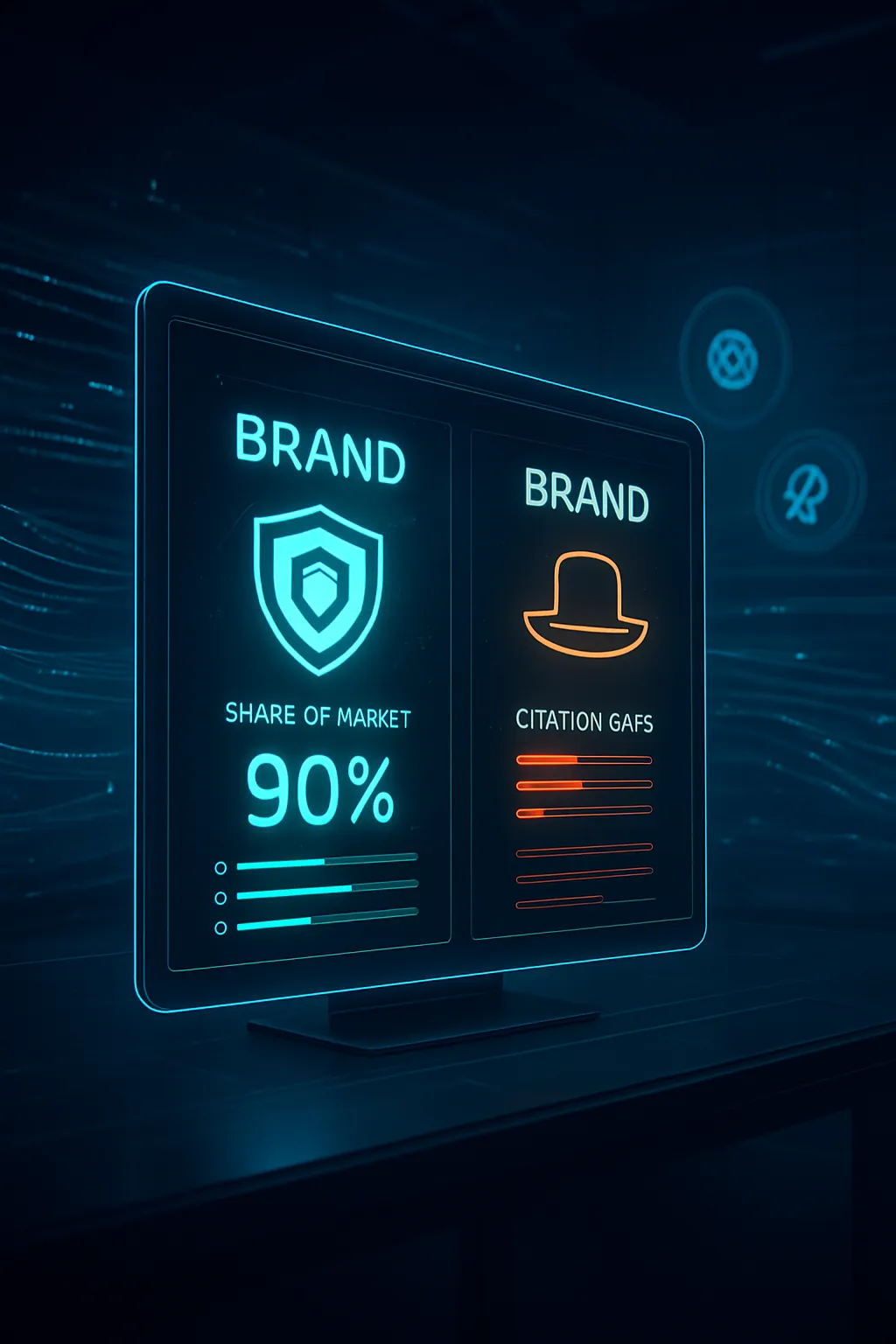
A Citation Gap occurs when an AI engine consistently cites a competitor for a specific high-value query while ignoring your brand, despite your brand having relevant content. This usually happens because your content isn't formatted for Answer Engine Optimization (AEO) or the AI perceives the competitor's source as more authoritative or easier to parse.
Impact-wise, a Citation Gap is a direct leak in your marketing funnel. If the AI doesn't mention you during the research phase, you are never even considered for the short-list. To close these gaps, you must identify the "missing" content formats—perhaps the AI prefers the competitor's structured comparison tables or their direct, question-and-answer style documentation. For more on protecting your brand from these gaps, read about Defensive AEO vs Competitor Hijacking.
How do I use AI audit data to refine my long-tail content strategy?
Use audit data to identify the exact questions users are asking that result in competitor citations, then create "Better-Than" content that directly answers those questions with more precision. If your audit shows that Perplexity cites a competitor for the question "How do I integrate [Software] with [Platform]?", your task is to create a more comprehensive, structured, and easy-to-read guide on that exact topic.
In 2026, the most effective content for AEO is "Atomic Content"—short, modular blocks of information that an LLM can easily extract. Instead of a 3,000-word sprawling guide, break your content into 10 distinct FAQ sections, each with a clear H2 and a direct 3-sentence answer. This makes your site a "citation magnet" for AI crawlers. For a broader look at this strategy, check out The Ultimate Guide to AI Visibility Audits.
Marketer-to-Dev Handoff: Automated Audit Script
If you want to move beyond manual searching, give this Python snippet to your technical team. It uses a basic API call structure to compare how two brands are mentioned in an LLM output, helping you quantify your Share of Model.
import openai

# Simple script to compare brand mentions in an AI response
def compare_brands(prompt, brand_a, brand_b):
    response = openai.ChatCompletion.create(
        model="gpt-4o",
        messages=[{"role": "user", "content": prompt}]
    )
    answer = response.choices[0].message.content.lower()

    count_a = answer.count(brand_a.lower())
    count_b = answer.count(brand_b.lower())

    print(f"Results for: {prompt}")
    print(f"{brand_a} mentions: {count_a}")
    print(f"{brand_b} mentions: {count_b}")

    if count_a > count_b:
        return f"{brand_a} is the citation leader."
    else:
        return f"{brand_b} is the citation leader."

# Example usage for a marketer
# compare_brands("Who are the top innovators in sustainable fintech?", "GreenPay", "EcoBank")
Question bank for your next content strategy sessions
Use these questions to guide your next AEO-focused content audit:
- Which competitor is the 'default' recommendation for our primary use case?
- Does the AI mention our pricing accurately compared to our competitors?
- What third-party review sites are being cited as sources for our brand sentiment?
- Are our product's unique selling points (USPs) being highlighted or ignored?
- Which long-tail 'how-to' questions are currently owned by our rivals?
- Is the AI hallucinating features for our competitors that we actually provide?
- What is the reading level of the sources the AI prefers to cite?
- How does our Share of Model change when the query includes the word 'cheap' vs. 'enterprise'?
- Are our executive leaders being cited as thought leaders in industry summaries?
- Which technical documentation pages are most frequently used as grounded data?
Related questions users ask in ChatGPT/Perplexity
- "How do I get my company cited in ChatGPT answers?"
- "Why is my competitor showing up in Google AI Overviews but I'm not?"
- "What is the best way to monitor brand mentions in AI search?"
- "How do LLMs choose which websites to use as sources?"
- "Can I pay to be a featured brand in AI assistant responses?"
- "How do I fix incorrect information about my brand in Claude?"
Your 30 / 60 / 90 Day Competitive AI Audit Plan
Days 1–30: The Baseline Phase
- Audit: Manually test 50 core business queries across ChatGPT, Claude, and Perplexity.
- Identify: List the top 3 competitors consistently appearing in citations.
- Baseline: Calculate your current Share of Model (SOM) for these queries.
Days 31–60: The Optimization Phase
- Content Gap Fill: Create 10 new FAQ-style pages targeting the specific 'Citation Gaps' identified in month one.
- Technical AEO: Ensure all new content uses clean HTML and clear headers to facilitate AI crawling.
- Monitoring: Implement a tool like Brand Armor to track daily fluctuations in your AI visibility.
Days 61–90: The Scaling Phase
- Expansion: Move beyond core queries to long-tail, top-of-funnel educational questions.
- PR Alignment: Coordinate with your PR team to get mentions in the third-party publications that the AI assistants are using as primary sources.
- Review: Re-run your 50-query audit and measure the growth in your SOM and citation frequency.
Final Thoughts
Competitive analysis in the age of AI is no longer about beating a competitor on a static page; it’s about becoming the most trusted, citable authority in the eyes of the models. By conducting regular AI search audits, you can stop guessing why your traffic is shifting and start taking proactive steps to ensure your brand is the answer the world receives.
Want to learn more about protecting your brand in the age of generative search? Explore our latest resources on Brand Armor AI.
Stay visible as AI search evolves
Practical research on AI visibility, citations, crawler activity, shopping recommendations, and GEO strategy.
Useful insights only. Unsubscribe anytime.