
How Do I Benchmark My Brand Against Competitors in AI Search?
Learn how to conduct an AI brand visibility competitive analysis to benchmark your brand against rivals in ChatGPT, Perplexity, and Claude for better AEO.
How Do I Benchmark My Brand Against Competitors in AI Search?
In the marketing landscape of 2026, traditional share of voice has been replaced by AI Citation Share. If your brand is not being mentioned or cited by the major Large Language Models (LLMs), you are effectively invisible to a generation of users who no longer use traditional search engines. Benchmarking your brand against competitors in AI search results is the only way to identify why rivals are winning the 'answer' and how to reclaim your territory.
TL;DR
- AI Competitive Analysis measures your citation frequency versus competitors in LLM responses.
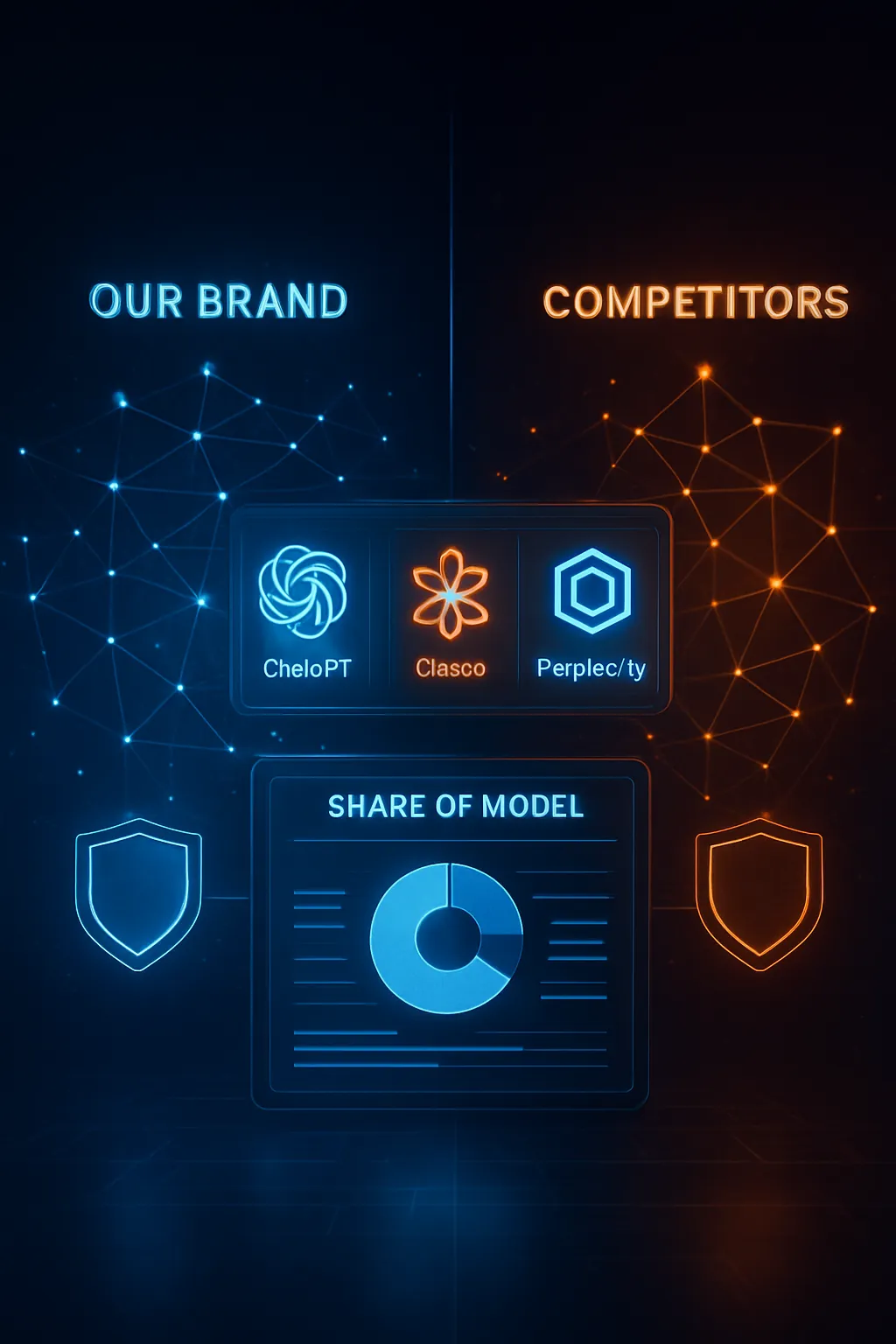
- Share of Model (SoM) is the new metric for 2026, replacing Share of Voice (SoV).
- Perplexity and ChatGPT prioritize brands that provide structured, factual data over marketing fluff.
- Citation Gap Analysis helps identify which third-party sites are feeding AI models the most data about your competitors.
- Action: Audit your top 10 industry prompts weekly to track visibility shifts.
Definition: AI Brand Visibility Competitive Analysis AI Brand Visibility Competitive Analysis is the systematic process of evaluating how frequently and prominently your brand appears in AI-generated responses compared to your direct competitors. It involves measuring citation frequency, sentiment accuracy, and the specific source domains that AI assistants like ChatGPT, Claude, and Perplexity use to validate information about your industry.
What is AI Brand Visibility Competitive Analysis?
AI Brand Visibility Competitive Analysis is the process of measuring your brand's presence, authority, and citation frequency within AI-generated answers relative to your competitors. Unlike traditional SEO, which tracks blue links, this analysis focuses on whether an LLM recommends your brand, how it describes your unique selling propositions (USPs), and which sources it cites to back up those claims.
In 2026, marketers use this analysis to uncover "Citation Gaps"—areas where a competitor is consistently mentioned for a specific solution while your brand is ignored. This benchmarking allows you to see the exact websites (Reddit, niche trade journals, or documentation sites) that the AI is using as its "truth" for your category. Tools like Brand Armor AI allow teams to automate this tracking across multiple LLMs simultaneously.
How Do I Measure My Brand's Share of Voice in AI Answers?
You measure your brand's Share of Voice (SoV) in AI answers by calculating the percentage of times your brand is mentioned or cited across a standardized set of industry prompts compared to your competitors. This is often referred to as Share of Model (SoM). To get an accurate reading, you must run a diverse battery of prompts—informational, transactional, and comparative—across ChatGPT, Claude, Gemini, and Perplexity.
To calculate your Share of Model, follow this three-step formula:
- Define the Prompt Set: Create 50–100 queries your customers ask (e.g., "What is the best enterprise CRM for mid-sized healthcare firms?").
- Run and Log: Input these into various LLMs and record which brands are mentioned in the first paragraph.
- Calculate Percentage: (Your Brand Mentions / Total Mentions of All Competitors) x 100.
By establishing this baseline, you can see if your Answer Engine Optimization (AEO) efforts are actually moving the needle or if your competitors are successfully hijacking the narrative.
Why Does My Competitor Get Cited More Often in Perplexity?
Competitors often get cited more in Perplexity because they have a higher volume of "factual density" on high-authority domains that Perplexity’s crawler prioritizes. Perplexity is an answer engine that relies heavily on real-time web indexing; if a competitor has recently published white papers, updated their documentation, or been featured in recent technical reviews, they are more likely to be cited.
Another reason is the use of structured data and clear definitions. If a competitor’s site uses clear, non-promotional language that answers a specific question in the first two sentences, it is much easier for an AI agent to extract that information as a citation. If your content is buried behind gated PDFs or written in flowery marketing jargon, the AI will bypass it in favor of a competitor's more accessible, "citation-ready" content. Using a brand monitoring tool can help you identify exactly which pages are winning these citations.
How Do I Audit Competitor Citations for Answer Engine Optimization?
To audit competitor citations for AEO, you must identify the specific URLs that AI assistants reference when they mention your rivals. This involves clicking the citation numbers in Perplexity or checking the "Sources" or "Search" links in ChatGPT and Claude. Once you have a list of these URLs, you can analyze the content structure, the sentiment, and the domain authority of those sources.
Follow this audit checklist:
- Source Type: Are the citations coming from the competitor's own site, or from third-party reviews, Reddit, or Wikipedia?
- Content Format: Is the cited content a listicle, a technical FAQ, or a press release?
- Keyword Proximity: How close is the competitor's brand name to the primary keyword in the cited text?
- Refresh Rate: How old is the content being cited? (AI models often prefer recent data for fast-moving industries).
Mapping these citations reveals the "Source Map" you need to influence. If 40% of competitor citations come from three specific industry forums, your next move is to ensure your brand has a presence on those forums.
Which Metrics Matter for Benchmarking AI Search Results?
The metrics that matter for benchmarking AI search results are Citation Share, Sentiment Polarity, and Source Authority. In 2026, traditional metrics like "Domain Rating" are secondary to how an LLM perceives your brand's relevance to a specific user intent. You need to track how the AI describes your brand—is it the "affordable option," the "premium leader," or the "legacy player"?
| Metric | Definition | Why it Matters in 2026 |
|---|---|---|
| Citation Share | % of total citations in a category belonging to your brand. | Directly correlates to lead generation and trust. |
| Inclusion Rate | How often your brand appears in a list of "top" recommendations. | Measures your brand's presence in the consideration set. |
| Source Diversity | The number of unique domains the AI cites to verify your brand. | High diversity prevents a single site from tanking your reputation. |
| Sentiment Score | The AI's tone when describing your brand (Positive, Neutral, Negative). | Influences user perception and final conversion. |
| Hallucination Rate | How often the AI provides incorrect or outdated info about you. | Critical for brand protection and legal compliance. |
How this maps to SEO vs AEO vs GEO
Understanding where competitive analysis fits requires distinguishing between the three pillars of modern search visibility.
| Pillar | Primary Goal | Competitive Benchmark | Who Owns It |
|---|---|---|---|
| SEO (Search Engine Optimization) | Rank #1 on Google Search | Keyword Rankings & Backlinks | SEO Specialist |
| AEO (Answer Engine Optimization) | Become the cited answer in AI chat | Citation Share & Factual Density | Content Strategist |
| GEO (Generative Engine Optimization) | Influence the LLM's internal weights | Sentiment & Contextual Association | Growth/Brand Lead |
How this helps you show up in ChatGPT, Claude, or Perplexity
Benchmarking isn't just about watching the scoreboard; it’s about reverse-engineering the AI's logic. When you see that ChatGPT consistently cites a competitor’s "Product Comparison" page, it tells you that the LLM values that specific comparison framework. To compete, you must create a more comprehensive, more factual, and more easily crawlable version of that content.
For marketers, this means:
- In ChatGPT: Focus on being mentioned in the "Search" phase by having high-quality PR and news mentions.
- In Claude: Focus on long-form, context-rich technical documentation, as Claude excels at processing deep context.
- In Perplexity: Focus on real-time data, structured lists, and being featured on high-authority news sites.
Monitoring these platforms through Brand Armor ensures you are notified the moment a competitor gains a significant citation advantage.
What to tell your team in one sentence
"We are no longer just competing for clicks; we are competing for the AI's trust, and our competitive analysis must now track who the LLMs cite as the definitive source for our industry."
Technical Implementation: Automating Competitive Mention Tracking
If you want to move beyond manual prompting, you can use a simple Python script to query an LLM API and compare brand mentions. This allows you to benchmark hundreds of queries in minutes rather than hours.
import openai

# A simple script for marketers to benchmark brand mentions
def benchmark_brands(prompt_list, competitor_list):
    client = openai.OpenAI(api_key="YOUR_API_KEY")
    results = []

    for query in prompt_list:
        response = client.chat.completions.create(
            model="gpt-4o",
            messages=[{"role": "user", "content": f"Recommend the best software for {query}."}]
        )
        answer = response.choices[0].message.content

        # Check which brands from our list are in the answer
        mentions = [brand for brand in competitor_list if brand.lower() in answer.lower()]
        results.append({"query": query, "mentions": mentions})

    return results

# Example Usage
queries = ["B2B lead generation", "AI content security", "brand protection"]
my_competitors = ["Brand Alpha", "Brand Beta", "MyBrand"]
print(benchmark_brands(queries, my_competitors))
Related Blog Posts
- Brand Visibility in AI Answers: The 2026 Playbook
- AI Search Visibility: AEO vs. Traditional SEO for Marketers
- AI Monitoring vs. Traditional SEO Tools: The 2026 Marketer's Guide
Related questions people ask in ChatGPT/Perplexity
How does AI determine which brand to recommend? AI models determine recommendations based on a combination of training data (historical authority), RAG (Retrieval-Augmented Generation) from real-time web searches, and the factual consistency of the brand’s online presence. They prioritize brands that are frequently associated with positive, authoritative context across multiple trusted domains.
Can I pay to be cited in AI search results? As of 2026, there is no direct "pay-to-play" citation model for the organic answers in ChatGPT or Claude. However, sponsored links may appear in Google AI Overviews or Perplexity. To influence the organic (unpaid) citations, you must use AEO strategies to improve your organic authority and factual accessibility.
How often should I run a competitive analysis for AI search? Because LLMs are updated frequently and answer engines like Perplexity crawl the web in real-time, you should run a high-level competitive audit at least once a month. For high-stakes industries, weekly monitoring is recommended to catch "citation hijacking" where a competitor updates their content to steal your primary citation slots.
What is a 'Citation Gap' in AEO? A Citation Gap occurs when an AI model cites a competitor for a specific query or feature that your brand also offers, but fails to mention you. This usually indicates that the AI does not find your content as authoritative, accessible, or clear as the competitor's version.
Want to learn more about protecting your brand's presence in the age of AI? Explore our comprehensive resources on Brand Armor AI.
Stay visible as AI search evolves
Practical research on AI visibility, citations, crawler activity, shopping recommendations, and GEO strategy.
Useful insights only. Unsubscribe anytime.