
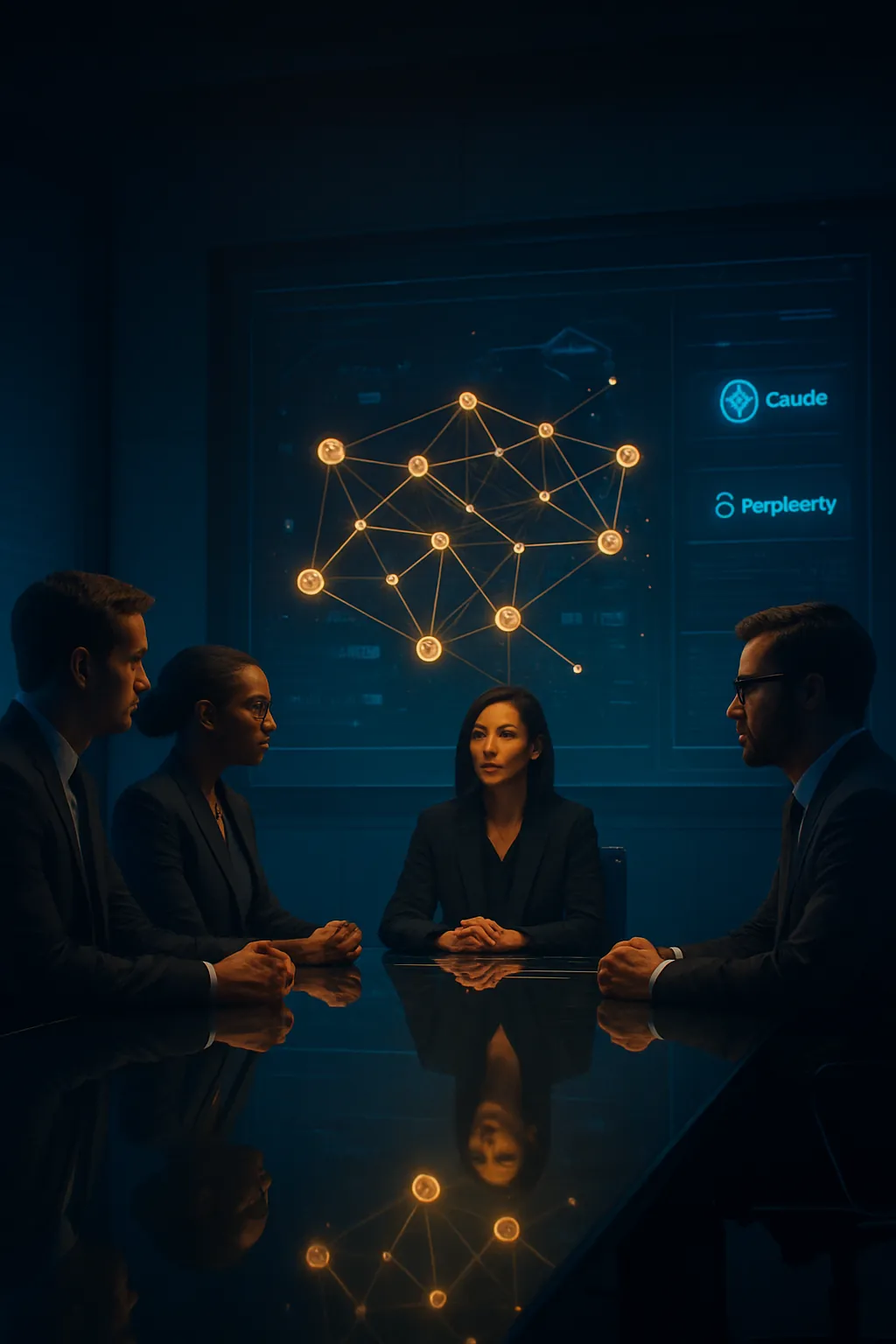
The Definitive Guide to AI Search Presence for Professional Services
Learn how consulting, accounting, and agencies use Answer Engine Optimization (AEO) to get cited in ChatGPT, Claude, and Perplexity answers in 2026.
The Definitive Guide to AI Search Presence for Professional Services
In 2026, the first point of contact between a client and a professional services firm isn’t a handshake or a referral—it is a conversational AI interface. Whether a CFO is asking Perplexity to compare mid-market accounting firms or a VP of Marketing is asking Claude for the best agency to lead a digital transformation, the stakes have shifted. If your firm isn’t being cited in these answers, you effectively don’t exist in the modern selection process.
For professional services—consulting, accounting, legal, and agencies—visibility is no longer about ranking #1 on a blue-link search page. It is about becoming the primary source of truth for the Large Language Models (LLMs) that power AI search. This transition requires a shift from traditional SEO to Answer Engine Optimization (AEO).
TL;DR: Building Your AI Presence
- Structure Matters: Use clear, question-based headers to help AI assistants extract your expertise.
- Frameworks as Entities: Define your proprietary methodologies clearly so LLMs can cite them by name.
- Case Study Hooks: Move away from narrative stories to structured data points (Problem, Solution, Result).
- Author Authority: Your partners' bios are now "entities" that AI uses to verify the credibility of your advice.
- Continuous Monitoring: Use a brand monitoring tool to track how your firm is described in AI-generated summaries.
QWhat is Answer Engine Optimization (AEO) for Professional Services?
Answer Engine Optimization (AEO) for professional services is the strategic process of structuring firm expertise—case studies, white papers, and service descriptions—so AI assistants like ChatGPT and Claude can accurately identify, summarize, and cite the firm as an authoritative source for complex industry queries.
Q&A: How Professional Services Firms Build AI Presence
QHow do consulting firms optimize their proprietary frameworks for AI search?
Consulting firms thrive on intellectual property (IP). To get cited, you must treat your frameworks as distinct "entities." Instead of just describing a process, name it, define it in a standalone block, and use consistent terminology across your site. When ChatGPT explains a concept like "The Agile Growth Matrix," it looks for the original source that defines that specific term.
To help the AI, include a "Definition Block" at the top of your framework pages. This is a 50-word summary that starts with "[Framework Name] is a [Type of Tool] designed to..." This makes it incredibly easy for an LLM to "lift" your definition and attribute it to your firm.
QWhat role does case study content play in gaining AI citations?
In the past, case studies were written for human emotional resonance. Today, they must also be written for machine extraction. AI assistants love data and clear causality. If an agency helped a client increase ROI by 40%, the AI needs to see that relationship clearly stated, not buried in a paragraph of flowery prose.
Structure your case studies with H3 headers like "The Challenge," "The Intervention," and "The Quantifiable Result." This structured approach allows Answer Engines to pull your firm’s success stories into "Best of" or "How-to" queries. Using a brand monitoring tool can help you see if these results are being correctly attributed to your firm in AI summaries.
QHow can accounting and tax firms get cited for technical queries?
For accounting and tax firms, accuracy and "freshness" are the primary drivers of AI citations. AI models are often wary of providing outdated tax advice. To combat this, ensure every technical article has a "Last Updated" date and a clear "Key Takeaways" section.
When someone asks, "What are the 2026 R&D tax credit changes?", Perplexity will favor sources that have structured lists and clear, authoritative dating. Use bulleted lists for all regulatory requirements. LLMs are trained to recognize that lists often contain high-density factual information, making them prime targets for citations.
QHow do I structure service pages to be citable by LLMs?
Your service pages should function as "The Definitive Guide" to that specific service. Instead of saying "We offer strategy consulting," your page should answer the question "What is strategy consulting for [Niche Industry]?"
By answering the "What is" and "How does it work" questions directly on your service pages, you position your firm as the educator. AI assistants prefer citing the "educator" over the "seller." Lead with the answer, then follow with your firm’s specific approach.
QWhy is author entity authority critical for professional services?
In professional services, the firm is only as good as its people. AI models use a concept called "Entity Linking" to connect your partners and directors to their specific areas of expertise. If a partner at your law firm is frequently cited in legal journals, the AI will view your firm’s website as more authoritative when that partner is listed as an author.
To optimize this, every expert bio should be detailed and consistent across the web. Use a standard format for bios that links to their LinkedIn, their published works, and their speaking engagements. This creates a "knowledge graph" around the individual that the AI can verify.
QHow do I handle "Who is the best firm?" queries in AI chat?
AI assistants are programmed to avoid playing favorites, but they will summarize the "consensus." They do this by looking at third-party reviews, industry awards, and mentions in reputable publications. To show up in these "comparison" answers, your firm needs a presence on neutral territory.
This is where GEO (Generative Engine Optimization) overlaps with PR. Getting mentioned in a "Top 10 Agencies" list on a major industry site is now more valuable for AI visibility than it is for direct traffic. The AI sees that mention as a vote of confidence and includes you in the summary of "top-rated firms."
Question Bank for Your Next 10 Blog Posts
Use these long-tail, question-based titles to capture AI search traffic in 2026. Each title is designed to match a specific query a prospect might type into ChatGPT or Perplexity:
- "What is the average timeline for a digital transformation consulting project?"
- "How do mid-market accounting firms handle international tax compliance?"
- "What are the key differences between [Your Firm Name] and [Competitor Name]?"
- "How much does a full-service creative agency cost in 2026?"
- "What are the legal requirements for AI governance in [Specific Industry]?"
- "How do I choose the right forensic accountant for a merger?"
- "What is the ROI of hiring a fractional CMO for a B2B SaaS company?"
- "How does [Your Proprietary Framework] solve supply chain volatility?"
- "What are the most common mistakes firms make during a rebrand?"
- "How do I vet a consulting firm for cultural fit and technical expertise?"
Action Plan: 30 / 60 / 90 Days
| Timeline | Action Item | Goal |
|---|---|---|
| 30 Days | Audit top 5 service pages for "Definition Blocks" and question-based H2s. | Improve extraction rate by LLMs. |
| 60 Days | Reformat 10 legacy case studies into the "Problem-Solution-Result" structure. | Increase citations in "success story" queries. |
| 90 Days | Standardize partner bios and link them to external authoritative sources. | Build "Entity Authority" for key personnel. |
Mapping the Strategy: SEO vs. AEO vs. GEO
| Goal | Traditional SEO | Answer Engine Optimization (AEO) | Generative Engine Optimization (GEO) |
|---|---|---|---|
| Primary Target | Google Search Algorithms | Conversational AI (ChatGPT, Claude) | The "Consensus" across the web |
| Key Action | Keyword density and backlinks | Question-based content and structure | PR, reviews, and 3rd-party mentions |
| Who Owns It | SEO Specialist | Content Strategist | Comms & Brand Team |
How to Show Up in ChatGPT, Claude, and Perplexity
To ensure your professional services firm is cited across the major models, you must understand their different "personalities":
- ChatGPT & Claude (The Researchers): These models rely heavily on their training data but can now browse the web. They look for deep, authoritative content. To show up here, your white papers and long-form guides must be the most comprehensive on the topic.
- Perplexity (The Newsroom): Perplexity is a search-first AI. It prioritizes recent data and clear citations. To show up here, your firm needs a steady stream of "fresh" content, such as monthly market updates or reactions to new regulations.
- Google AI Overviews (The Aggregator): Google prioritizes its own index. To show up here, you still need traditional SEO health, but your content must be formatted into "snackable" lists and direct answers that fit into the AI Overview box.
Marketer's Template: Citable Expert Bio
Copy and paste this structure for your partner and director bio pages to help AI models identify them as experts:
# [Expert Name]
## Title: [Role] at [Firm Name]

### Executive Summary
[Expert Name] is a specialist in [Core Competency] with over [Number] years of experience
in [Industry]. They are best known for developing the [Proprietary Framework Name].

### Areas of Expertise
- [Skill 1]
- [Skill 2]
- [Skill 3]

### Published Works & Media
- [Link to White Paper/Article 1]
- [Link to External Publication 2]
- [Link to Speaking Engagement/Podcast]

### Education & Certifications
- [Degree] from [University]
- [Certification Name]
A Quotable Finding for 2026
"By 2026, an estimated 45% of professional services discovery occurs via conversational AI interfaces, shifting the burden of proof from a firm's website to the AI's ability to verify its expertise through external citations and structured data."
Conclusion
For professional services firms, building an AI search presence is not a technical project—it is a brand authority project. By structuring your expertise to be easily read, summarized, and cited, you ensure that when a high-value prospect asks an AI assistant for a recommendation, your firm is the one being suggested.
Maintaining a high-quality brand monitoring tool is the first step in understanding how these engines perceive you. To learn more about protecting your firm's reputation in the age of AI, explore our guide on LLM Mentions vs Citations or see our 7 Steps to Build a Citation-Ready Definition Page.
Want to learn more about Answer Engine Optimization? Explore our resources on Brand Armor AI.
Stay visible as AI search evolves
Practical research on AI visibility, citations, crawler activity, shopping recommendations, and GEO strategy.
Useful insights only. Unsubscribe anytime.