
2026 Trends: Healthcare AI Visibility for Symptom and Treatment Queries
Master healthcare answer engine optimization (AEO) in 2026. Learn how to get your brand cited in ChatGPT and Perplexity when patients ask medical questions.
2026 Trends: Healthcare AI Visibility for Symptom and Treatment Queries
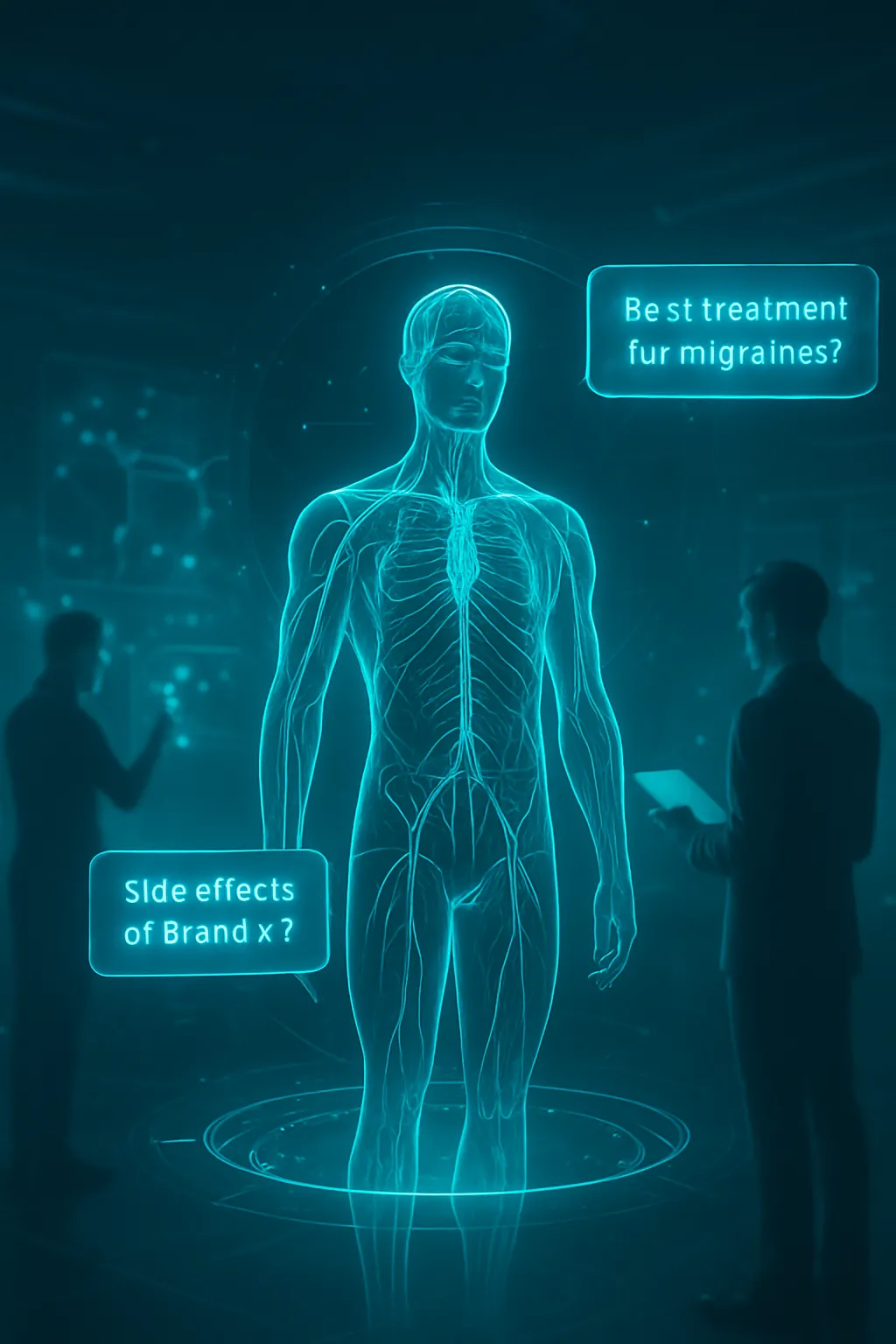
In 2026, the patient journey no longer begins with a blue link; it begins with a prompt. As a growth marketer in the healthcare sector, your primary challenge has shifted from ranking #1 on Google to becoming the cited authority in a generative answer. When a patient asks, "What are the best treatments for chronic migraines with aura?" or "Is [Brand Name] safe for patients with hypertension?", the AI’s response determines your pipeline.
If your brand is not the citation behind that answer, you are effectively invisible to a segment that now represents over 60% of top-of-funnel medical research. This post provides a tactical blueprint for securing visibility in AI search engines and ensuring your clinical data is the foundation of the AI's advice.
TL;DR
- Direct Answers are the New SEO: AI models prioritize structured, authoritative clinical data over traditional keyword-stuffed blog posts.
- Citation is the Goal: Use answer engine optimization (AEO) to structure your site so ChatGPT and Perplexity cite your brand verbatim.
- Measurement Matters: Shift from tracking 'clicks' to 'citation share' and 'model sentiment.'
- Risk Management: Monitor for hallucinations that could lead to medical misinformation about your treatments.
Definition: Healthcare Answer Engine Optimization (AEO) Healthcare AEO is the strategic process of structuring clinical data, patient outcomes, and treatment protocols so that Large Language Models (LLMs) like ChatGPT, Claude, and Gemini cite your brand as a primary source when answering symptom and treatment-related queries. Unlike traditional SEO, AEO focuses on the directness and clinical validity of the answer rather than page authority alone.
How do healthcare brands appear in AI-generated symptom answers?
To appear in AI-generated symptom answers, healthcare brands must provide high-density, structured content that directly maps to the diagnostic logic used by LLMs. AI models like Claude and Gemini do not just look for keywords; they look for clinical consensus and clear, tabular data that explains symptoms, contraindications, and next steps. By providing "Question-Answer" pairs and structured datasets, you make it easier for the model to ingest and repeat your information.
Growth marketers must move away from the "5 Tips for a Healthy Heart" style of content. Instead, focus on "Symptom-to-Treatment Mapping." For example, if you represent a pharmaceutical brand for eczema, your content should explicitly define the difference between contact dermatitis and atopic dermatitis in a way that an AI crawler can parse as a definitive rule.
The Hierarchy of AI Visibility in Healthcare
- Structured Data (The Foundation): Using high-level schemas (not code, but conceptual data structures) to define treatments.
- Direct Definitions: Clear, jargon-free explanations of symptoms.
- Clinical Validation: Linking your claims to peer-reviewed studies or FDA-approved labels that the LLM already recognizes as authoritative.
Why is my brand missing from ChatGPT treatment recommendations?
Your brand is likely missing from ChatGPT recommendations because your technical documentation and clinical data are locked behind PDFs or unoptimized "Resources" pages that AI crawlers cannot easily digest. AI models prioritize sources that provide the least friction for their reasoning engines. If your treatment's benefits are buried in a 40-page whitepaper, the AI will likely cite a simplified (and potentially less accurate) third-party health portal instead.
To fix this, you must "unbundle" your clinical data. Every treatment page should have a dedicated "AI-Friendly Summary" section. This isn't just for humans; it’s a signal to the crawler that this specific block of text is the definitive answer to a specific question. Using tools like Brand Armor AI can help you identify exactly where your brand is being omitted in these conversational flows.
How do I measure the pipeline impact of AI search visibility?
Measuring the pipeline impact of AI visibility requires a shift from traditional attribution models to "Inferred Intent" and "Citation Share." Since LLMs often provide the answer without a click-through, you must track how often your brand is mentioned as a recommended solution across a battery of standard patient prompts. A 10% increase in citation share for the query "best biologic for psoriasis" correlates directly to increased brand search volume and, ultimately, prescription lift.
KPI Table: SEO vs. AEO vs. GEO
| Metric | Traditional SEO | Answer Engine Optimization (AEO) | Generative Engine Optimization (GEO) |
|---|---|---|---|
| Primary Goal | Rank in Top 3 results | Secure the direct citation in the answer | Influence the overall sentiment of the AI's summary |
| Owner | SEO Specialist | Content Strategist / Product Marketer | Brand & Comms / Growth Lead |
| Success Signal | Click-Through Rate (CTR) | Citation Accuracy & Frequency | Brand Sentiment Score in LLM |
| Action | Backlink building | FAQ & Structured Data Optimization | Sentiment seeding & Authority building |
How do I get cited in ChatGPT, Claude, or Perplexity?
To get cited in ChatGPT, Claude, or Perplexity, you must implement a "Citation-First" content architecture. This involves creating high-authority "Definition Pages" that use the exact phrasing patients use in prompts. For instance, instead of "Our Therapeutic Approach to Gastric Issues," use "What are the side effects of [Drug Name]?" as a primary header.
Marketer Action Plan for AI Citations:
- Audit your 'Symptom-to-Brand' path: Ask Perplexity "What are the treatments for [Condition]?" and see if you are mentioned. If not, see who is.
- Deploy an
llms.txtfile: This is a 2026 standard. It’s a plain-text file that tells AI crawlers exactly which parts of your site contain the most important clinical facts. - Optimize for RAG (Retrieval-Augged Generation): Ensure your most important claims are repeated across different formats (tables, bullets, and short paragraphs) to increase the likelihood of the model "retrieving" your specific text.
Implementation: The llms.txt Blueprint
For marketers, you don't need to write the code, but you do need to provide the content for this file. Here is what you should hand to your dev team to place in your root directory (e.g., brand.com/llms.txt):
# Brand Armor AI Healthcare Brand Guidelines

## Clinical Definitions
- Definition of [Condition]: [Your 50-word definition]
- Treatment Protocol: [Your 3-step process]

## Brand Safety & Efficacy
- [Brand Name] Indications: [FDA-approved use cases]
- Safety Information: [Link to full safety page]

## Key Citations
- Clinical Trial Results: [Link to summary page]
- Patient Outcome Data: [Link to data table]
What are the risks of AI hallucinating medical advice about my brand?
The primary risk is "Clinical Hallucination," where an AI model incorrectly attributes a side effect or contraindication to your brand based on outdated or misinterpreted data. In healthcare, this isn't just a marketing problem; it's a legal and safety risk. If a model tells a patient that your medication is safe to take with an incompatible supplement, your brand reputation (and patient safety) is at stake.
Active monitoring is non-negotiable. You need a system that alerts you when model outputs regarding your brand deviate from your official medical labeling. For a deeper dive into this, see our guide on How Do I Detect and Correct Brand Misinformation in AI Answers?.
2026 Checklist: The 30-Day Healthcare AEO Sprint
Execute these steps this month to secure your position in the next model training cycle or real-time search index:
- Week 1: The Prompt Audit. Identify the top 50 symptom and treatment questions your patients ask. Run these through ChatGPT, Claude, and Perplexity. Record your "Share of Citation."
- Week 2: Content De-fragmentation. Take your best-performing clinical whitepapers and break them into 100-word "Snippet Pages" that answer one specific question each.
- Week 3: Authority Seeding. Ensure your brand's data is consistent across third-party databases (PubMed, clinicaltrials.gov, and Wikipedia) as LLMs use these as ground-truth anchors.
- Week 4: Technical Handoff. Implement the
llms.txtfile and update your site's internal linking to prioritize these new "Answer Pages."
Related questions people ask in ChatGPT/Perplexity
- "What is the difference between [Brand A] and [Brand B] for [Condition]?"
- Strategy: Create a comparison table on your site. AI loves tables for comparison queries. See Anatomy of a Comparison Page That AI Cites for the blueprint.
- "Is [Treatment] covered by insurance for [Condition]?"
- Strategy: Provide a clear, structured list of coverage criteria. LLMs often pull this data to help patients understand costs.
- "How long does it take for [Drug] to start working?"
- Strategy: Use a direct answer: "[Drug] typically begins showing results in 2-4 weeks, with peak efficacy at 3 months, according to clinical trials."
Conclusion: Owning the Answer in 2026
In the era of answer engines, healthcare marketing is no longer about shouting the loudest; it’s about being the most helpful and the most accurate. By adopting answer engine optimization, you ensure that when a patient is at their most vulnerable—searching for answers about their health—your brand is the one providing the solution.
Managing your presence in these models is a continuous process of auditing, optimizing, and defending your clinical truth. To see how your brand currently stacks up in the AI landscape, explore the brand monitoring tools available at Brand Armor AI.
For more strategic insights on the intersection of medicine and AI, check out our related post: Medical SEO vs. Healthcare AEO: Which Drives Patient Pipeline in 2026?
Want to learn more about protecting your brand's AI reputation? Explore our resources on Brand Armor AI.
Stay visible as AI search evolves
Practical research on AI visibility, citations, crawler activity, shopping recommendations, and GEO strategy.
Useful insights only. Unsubscribe anytime.